Research-based risk mitigation is imperative for the effective management of internal browning. By Catherine Milward-Bridges
Dr Elke Crouch led a research project with a major focus on the associated risks of internal browning (IB) development in Cripps Pink apples. IB is a physiological disorder that breaks down apple flesh. It constitutes a chemical reaction (oxidation) that results from membrane and cellular failure.
There are two types of IB – diffuse browning (DB) and radial browning (RB), DB being historically more common in SA. Combination browning (CB) arises when both DB and RB are present in the same fruit.
Storage best practices for Cripps Pink and its clones mitigate effectively against IB in the South African apple industry.
However, the zero-tolerance approach of retailers to browning increases the risk for claims while seasonal fluctuation in browning incidence and the poor understanding thereof may diminish consumer trust.
Background
The research project sought to explore unanswered questions regarding IB of Cripps Pink apples. The project was co-funded 50-50 by the Department of Science, Technology and Innovation (DSTI) and Hortgro. Under the Post-Harvest Innovation (PHI) Programme – a public-private partnership – the Fresh Produce Exporters’ Forum (FPEF) served as the implementation agent.
“We cannot predict IB accurately yet, but we can highlight the risk factors,” notes Crouch. She was speaking from the premise of the multi-factorial predisposition of Cripps Pink and its clones to IB in different growing regions and seasons.
An integrated approach is integral to the effective overall management of IB. Ongoing combined climate monitoring, canopy management, and maturity-specific storage practices all contribute to postharvest consistency, extended storage life, and fruit quality that meets premium market standards.
Cripps Pink apples
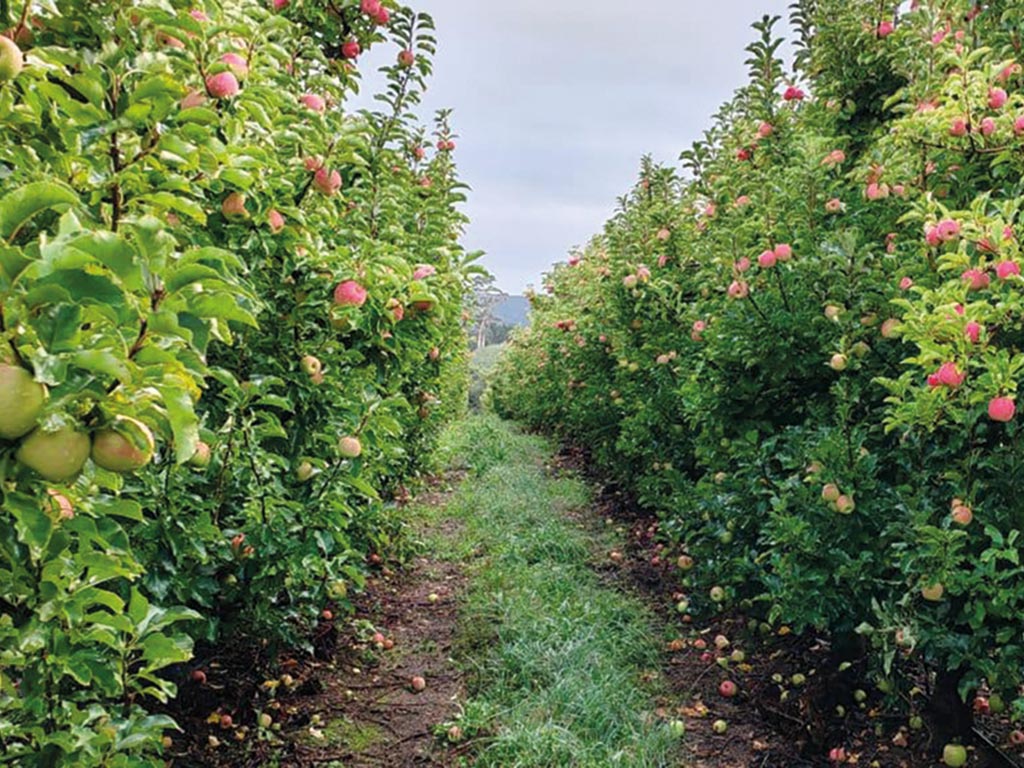
Fruit- and orchard-specific factors like irrigation practices, pre-harvest spray applications (for which there is currently limited research), maturity, fruit size, current and previous season yield (crop load), and tree age should all be considered as contributing factors to IB development.
Pre-harvest temperature and the accumulation of growing degree days (GDD) above 10 °C from full bloom to harvest, are also important considerations. GDD refers to the thermal time index that quantifies heat accumulation above a defined base temperature (in this case, 10 °C).
A good understanding of the factors involved and the seasonal risk of IB development due to temperature can facilitate effective postharvest management to reduce risk and optimise market planning strategies. Table 1 provides a summary of relevant IB risks that were identified in this study. And below is a comparison of pre- and postharvest factors that influence browning types. This comparative knowledge is instrumental in investigating relevant research gaps (Ramos, 2026).
Pre-harvest
This phase can be thought of as the genesis of IB risks – where it all begins.
Teams in storage facilities must develop a good understanding of relevant pre-harvest risk factors and the apple profiles that they receive. This will equip them to significantly reduce browning risk by adjusting their storage methods and duration accordingly.
The effects of internal browning
Orchard/quality factors
RB risk increased when previous and current yields exceeded 70-80 t/ha and fruit size was below 69 mm, in the current season. CO2 core browning was most prevalent in orchards with high tree row volumes (>2 200 L) and large fruit (>140 g) with Total Soluble Solids (TSS) <14%. CO2-induced disorders, including flesh browning and internal cavities, were strongly associated with seedling rootstocks, vigorous canopies, and advanced starch breakdown. High yields (>79-82 t/ha) helped minimize CO2 flesh browning and core cavities, and higher acidity [titratable acid (TA) ] reduced browning risks (Ramos, 2026).
Ripening rate
The highest DB incidence was associated with a faster change in ground colour, increase in mass, faster starch breakdown, and a lower blush percentage and colour intensity, and after-storage TA and firmness.
The highest RB incidence was associated with the slowest increase in fruit circumference, mass, seed colour change and starch breakdown.
Temperature
Climatic factors
Thermal conditions during the growing and ripening phases dictate fruit quality maintenance in storage. RB incidence is lower in cooler seasons that have a warmer ripening period shortly before harvest. In contrast, DB is triggered by extreme temperature spikes and high maximum temperatures in the final month before harvest. These temperature surges appear to cause a faster starch breakdown and more mature fruit, reducing the fruit’s tolerance to long-term cold storage.
However, DB risk is lower in longer growing seasons (≥188 days) with a cooler ripening period.
CO2-induced disorders like core browning and core cavities are least likely after warmer cumulative growing seasons, whereas flesh cavities are exacerbated by low heat units [growing degree hours (GDH) ] in the four weeks leading up to harvest. GDH measures heat accumulation to predict plant development stages (Ramos, 2026).
Harvesting
Harvesting inner and outer canopy fruit together and disregarding their distinct difference in maturity pose a significant risk of IB development when the fruit are stored together.
Other important considerations for risk avoidance include harvesting at optimum maturity and placing fruit in cold storage, soonest after harvesting, to reduce maturity progression before storage.
Unrefrigerated transport over long distances after harvesting in hot conditions causes starch breakdown to reach post-optimum levels, even though fruit were harvested at optimum starch breakdown. This results in high IB during low-oxygen, long-term storage (Ramos, 2026).
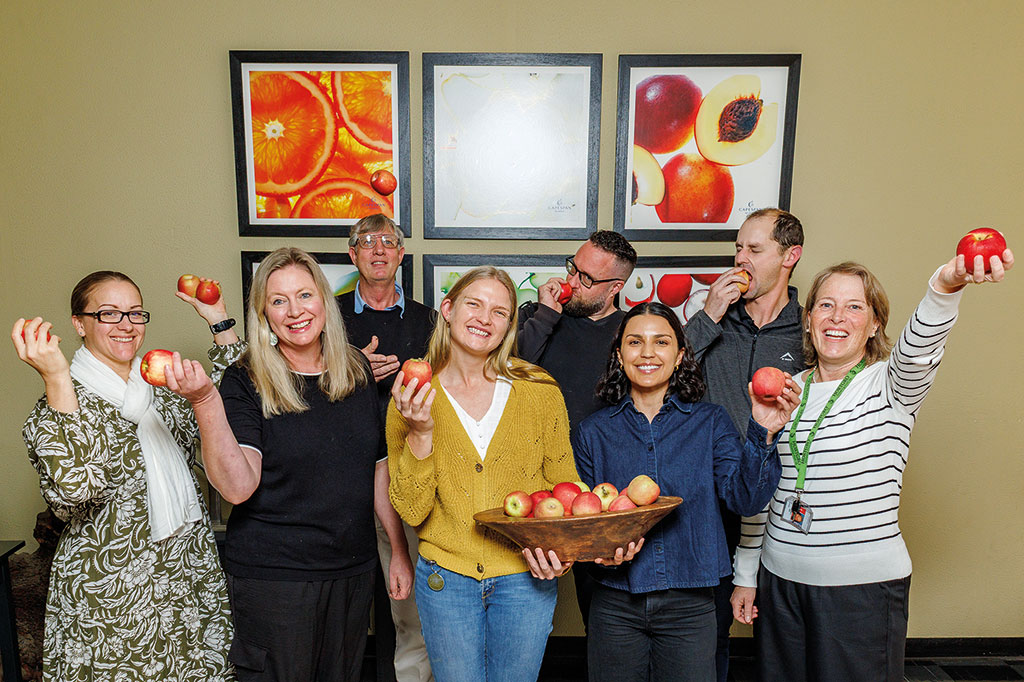
Back, from left: Ian Crouch (ExperiCo), Garth Stevens (SU Centre for Geographical Analysis), Daniël Viljoen (ExperiCo). Front, from left: Heleen Tayler*, Dr Elke Crouch (project lead), Ineke de Jongh*, Daniela Ramos*, and Dr Mariana Jooste. *Participating students at the time.
Postharvest
Long-term storage regimes
There are various long-term storage regimes available to effectively manage IB incidence.
Long-term storage technology
Dynamic Controlled Atmosphere Chlorophyll Fluorescence (DCA-CF) regulates oxygen at the lowest oxygen limit according to the fluorescence of the fruit, below 1 kPa. And it reduces the risk of browning disorders like superficial scald development in Granny Smith. Controlled atmosphere (CA) regulates oxygen at a constant oxygen level – in this trial, at 1.5 kPa.
Results showed that regardless of low-oxygen storage techniques, maturity played a bigger role in long-term storage than the storage technique employed. Storing fruit with a high starch breakdown in low-oxygen storage, for extended periods of time, will result in high IB (Ramos, 2026).
Literature also shows that in the case of RB, CO2 levels >1 kPa in CA were found to increase susceptibility. Cripps Pink and its strains are CO2-sensitive above 1 kPa (Jobling and James, 2008).
Long-term storage temperature
Similarly, the research team was confronted with the dilemma of decreased DB incidence when storing fruit at 3 °C, but with compromised fruit quality. Low storage temperatures possibly result in a stress response in fruit, increasing reactive oxygen species (ROS). And this physiological postharvest factor possibly overcomes the cell antioxidant capacity, giving rise to DB development. Research team member Heleen Tayler proved that step-down cooling from 3 to 1 °C works well in inhibiting disorder development, which is why it is included in three storage regimes in the industry best practice guidelines (Store-it Group, 2022).
For RB, an incidence decrease was also observed in these same trials when step-down cooling was applied from 3 to 1 °C. Therefore, the research team advises following the best practice guidelines closely to minimise overall IB incidence (Store-it Group, 2022).
1-Methylcyclopropene and Diphenylamine
Lower DB incidence was recorded in 1-Methylcyclopropene (1-MCP)-treated fruit (Butler, 2015; Crouch et al., 2015; de Jong, 2023; James, 2007; Majoni et al., 2013). These fruit also exhibited lower IB incidence (Majoni et al., 2013; Store-it Group, 2022). 1-MCP inhibits ethylene action, thereby retarding ripening and extending shelf life.
Regarding CO2-related browning, the application of Diphenylamine (DPA) – a postharvest chemical antioxidant – reportedly reduces the incidence of IB by retaining ascorbic acid levels and decreasing H2O2 production (de Castro et al., 2008).
Unfortunately, DPA is not allowed in many of our major markets, including the EU and UK.
Devising an effective, robust risk mitigation strategy for IB remains dependent on ongoing research.
Acknowledgements
Researchers: Dr Elke Crouch (project lead)
Research team: Heleen Tayler (a student at the time), Daniël Viljoen and Ian Crouch (both ExperiCo), Tara Southey (TerraClim), Garth Stevens [Centre for Geographical Analysis (CGA), Stellenbosch University (SU) ], and Dr Mariana Jooste (Hortgro).
Stakeholders: Hortgro and Pink Lady® SA
Technical assistance: ExperiCo Agri Research Solutions, G. Lötze (Horticultural Science, SU), DuToit Agri Maturity Indexing Lab, Koukamma Fruit Packers (Joubertina, Eastern Cape), Langkloof Fruit Solutions (Misgund, Eastern Cape).
Statistical assistance: Marieta Van der Rijst (ARC, Infruitec), Martin Kidd (SU), Adriaan Van Niekerk (CGA, SU), and Caley Higgs and Michaela Nortjé (TerraClim).
Growers: Farm owners and managers
Participating students: Ineke de Jong, Daniela Ramos, Heleen Tayler.
References
Butler, L, 2015. “Internal flesh browning of ‘Cripps Pink’ apple (Malus domestica Borkh.) as influenced by pre-harvest factors and the evaluation of near infrared reflectance spectroscopy as a non-destructive method for detecting browning.” (Master of Science). Stellenbosch University.
Crouch, E.M., Jooste, M., Majoni, T.J., Crouch, I.J., Bergman, H, 2015. “Harvest maturity and storage duration influencing flesh browning in South African ‘Cripps Pink’ apples.” Acta Hortic. 1079: 121-127.
de Castro, E., Barrett, D., Jobling, J., Mitcham, E., 2008. Biochemical factors associated with a CO2-induced flesh browning disorder of Pink Lady apples 48, 182-191.
De Jong, I, 2023. “‘Cripps Pink’ fruit quality affected by pre-harvest temperature, orchard factors, canopy position and long-term DCA-CF storage.” (Master of Science). Stellenbosch University.
James, H.J. (2007). “Understanding the flesh browning disorder of ‘Cripps Pink’ apples”. (Doctor of Philosophy). The University of Sydney.
Jobling, J., James, H.J., 2008. “Managing the flesh browning disorder of ‘Cripps Pink’ apples. A summary of Australian research investigating the causes and management of the problem.”
Majoni, T.J., Jooste, M., Crouch, E.M, 2013. “The effect of 1-MCP and storage duration on the storage potential and flesh browning development on ‘Cripps Pink’ apples stored under controlled atmosphere conditions.” Acta Hortic. 1007: 49-56.
Ramos, D., 2026. “Internal browning and other defects of ‘Cripps Pink’ apples – the effect of growing region temperature, canopy position and dynamic controlled atmosphere – chlorophyll fluorescence on fruit quality after long-term storage.” (Master of Science). Stellenbosch Universiy.
Store-it Group, 2022. “Best-practice guidelines for ‘Cripps’ Pink.”
Grapevine leafroll-associated viruses are costing growers by reducing fruit colour and quality. What are the latest results from SATI-funded research on this problem?
We use cookies on our website to give you the most relevant experience by remembering your preferences and repeat visits. By clicking “Accept All”, you consent to the use of ALL the cookies. However, you may visit "Cookie Settings" to provide a controlled consent.
This website uses cookies to improve your experience while you navigate through the website. Out of these, the cookies that are categorized as necessary are stored on your browser as they are essential for the working of basic functionalities of the website. We also use third-party cookies that help us analyze and understand how you use this website. These cookies will be stored in your browser only with your consent. You also have the option to opt-out of these cookies. But opting out of some of these cookies may affect your browsing experience.
Necessary cookies are absolutely essential for the website to function properly. These cookies ensure basic functionalities and security features of the website, anonymously.
Cookie
Duration
Description
cookielawinfo-checkbox-analytics
11 months
This cookie is set by GDPR Cookie Consent plugin. The cookie is used to store the user consent for the cookies in the category "Analytics".
cookielawinfo-checkbox-functional
11 months
The cookie is set by GDPR cookie consent to record the user consent for the cookies in the category "Functional".
cookielawinfo-checkbox-necessary
11 months
This cookie is set by GDPR Cookie Consent plugin. The cookies is used to store the user consent for the cookies in the category "Necessary".
cookielawinfo-checkbox-others
11 months
This cookie is set by GDPR Cookie Consent plugin. The cookie is used to store the user consent for the cookies in the category "Other.
cookielawinfo-checkbox-performance
11 months
This cookie is set by GDPR Cookie Consent plugin. The cookie is used to store the user consent for the cookies in the category "Performance".
viewed_cookie_policy
11 months
The cookie is set by the GDPR Cookie Consent plugin and is used to store whether or not user has consented to the use of cookies. It does not store any personal data.
Functional cookies help to perform certain functionalities like sharing the content of the website on social media platforms, collect feedbacks, and other third-party features.
Performance cookies are used to understand and analyze the key performance indexes of the website which helps in delivering a better user experience for the visitors.
Analytical cookies are used to understand how visitors interact with the website. These cookies help provide information on metrics the number of visitors, bounce rate, traffic source, etc.
Advertisement cookies are used to provide visitors with relevant ads and marketing campaigns. These cookies track visitors across websites and collect information to provide customized ads.