Preliminary results suggest that combining entomopathogenic nematodes (EPNs) with commercial adjuvants increases mealy bug mortality. By Anna Mouton
Scientists have long known that particular nematodes (entomopathogens) kill insects, but enlisting the minuscule worms in the fight against grapevine pests has proven challenging.
“The issue is that the EPNs are soil-dwelling, so they are prone to desiccation outside the soil,” says Gaylen Carelse, researcher at ExperiCo Agri-Research Solutions.
Carelse is leading an ongoing SATI-funded project investigating whether commercial adjuvants can improve EPN survival, thereby increasing their efficacy against vine mealy bugs (Planococcus ficus). The project was initially led by Dr Annika Pienaar, who has since joined Corteva Agriscience.
Why use adjuvants?
Previous research led by Dr Antoinette Malan of Stellenbosch University (SU) found that adjuvants boosted the efficacy of EPNs against vine mealy bugs. Adjuvants are compounds added to pesticides, herbicides, and plant growth regulators to facilitate their application or enhance their activity.
The mechanism by which adjuvants increase the efficacy of pesticides, herbicides, and plant growth regulators varies for different adjuvants:
Wetters and spreaders reduce droplet surface tension, allowing them to adhere to and spread on the target surface.
Stickers improve droplet adhesion.
Penetrants improve the uptake of active ingredients.
Extenders keep active ingredients effective for longer.
Humectants slow drying.
In addition to the humectants and sticker-spreaders tested by Malan and co-workers, the current project includes three others: a sticker-spreader and two organosilicone-based products. Organosilicones act as wetters, spreaders, and penetrants.
“The primary purpose of the adjuvants in our trials is to give the EPNs time to infect the mealy bugs,” says Carelse. “When you apply the EPNs, not all of them will land directly on a mealy bug. The adjuvants can allow them to make their way to the mealy bugs without drying out.”
“The primary purpose of the adjuvants in our trials is to give the EPNs time to infect the mealy bugs.”
EPNs versus mealy bugs
Before adding adjuvants, the project team tested four EPN species (Heterorhabditis bacteriophora, H. zealandica, Steinernema jeffreyense, and S. yirgalemense) obtained from SU against vine mealy bugs in the laboratory.
The researchers exposed individual adult female mealy bugs to suspensions of juvenile EPNs in water and checked for mealy bug mortality 24 and 48 hours later. Each EPN species was tested on 60 mealy bugs.
Juvenile EPNs kill insects by penetrating their bodies and releasing bacteria that liquefy the host tissues, usually resulting in death within 48 hours. The nematodes and bacteria feed on and multiply in the resulting soup. Eventually, the juice runs out, and a new generation of infective juveniles swarms from the cadaver, in search of fresh victims.
To confirm that EPNs caused mortalities in their trials, the researchers conducted post-mortem examinations under a microscope. They scrutinised each dead insect for nematodes in its body cavity. If none were present, the mealy bug died from other causes.
Of the four EPNs tested, three gave good results. The average mortality of the mealy bug females was approximately 82% for S. yirgalemense, 65% for H. zealandica, 62% for H. bacteriophora, and 10% for S. jeffreyense.
Mortality in the control mealy bugs, which were exposed to water without EPNs, was about 2%.
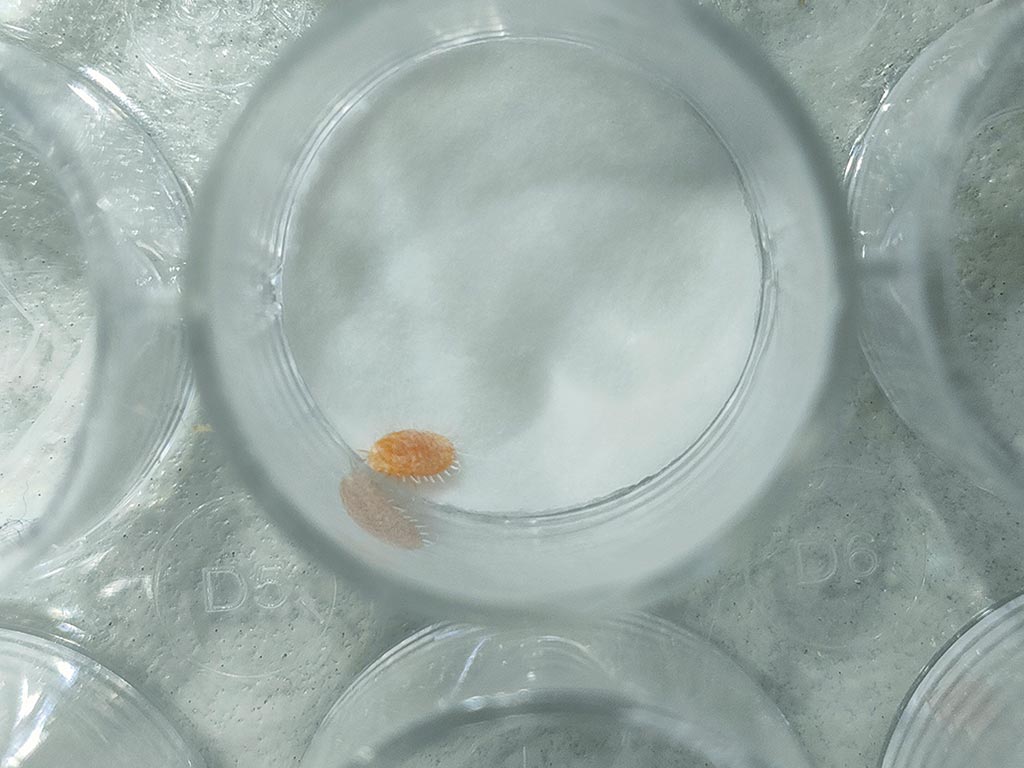
Individual mealy bugs were isolated for treatment with EPNs (Credit: ANNIKA PIENAAR)
The effect of adjuvants
As S. yirgalemense killed the most mealy bugs, it was selected for the next round of laboratory tests, in which the researchers compared juvenile nematodes suspended in one of five adjuvant formulations with nematodes in water.
Each treatment was applied to 12 grape-vine leaves, each of which held five adult female mealy bugs. The control mealy bugs were exposed to water (without adjuvants or EPNs).
The researchers removed the mealy bugs after 48 hours, keeping each individual isolated for up to 96 hours to monitor mortality. As before, they conducted mealy bug post-mortems to confirm the cause of death.
None of the control mealy bugs died. Mortality in the mealy bugs exposed to EPNs suspended in water was approximately 27%. In contrast, the adjuvants were associated with significantly higher mortality:
EPNs plus a combination of a humectant and a sticker-spreader: ± 75% mortality
EPNs plus either of two sticker-spreaders: ± 95% mortality
EPNs plus either of two organosilicone products: 100% mortality.
Although all the mealy bugs exposed to EPNs formulated with organosilicone adjuvants died, the insects had no EPNs in their bodies, indicating that the adjuvants, rather than the EPNs, caused the deaths.
The insecticidal properties of organosilicones have been demonstrated against several pests, including mealy bugs. For example, Dr Christopher Tipping and colleagues at the University of California, Davis, reported that an organosilicone surfactant could cause 100% mortality in mealy bug (Pseudococcus maritimus) crawlers.
The team also observed high mortality (above 90%) in immature and adult Western flower thrips (Frankliniella occidentalis) and Pacific spider mites (Tetranychus pacificus) exposed to organosilicones.
Next steps
Based on the laboratory results, the next phase of the project is field trials comparing S. yirgalemense suspended in water with a sticker-spreader formulation and an untreated control. The plan is to apply treatments to selected vines in a commercial vineyard with a natural mealy bug infestation.
“I’m excited about the fieldwork, to see whether we get similar results as in the lab,” says Carelse. “We want to move toward more sustainable and biological pest control and be less reliant on chemicals.”
We use cookies on our website to give you the most relevant experience by remembering your preferences and repeat visits. By clicking “Accept All”, you consent to the use of ALL the cookies. However, you may visit "Cookie Settings" to provide a controlled consent.
This website uses cookies to improve your experience while you navigate through the website. Out of these, the cookies that are categorized as necessary are stored on your browser as they are essential for the working of basic functionalities of the website. We also use third-party cookies that help us analyze and understand how you use this website. These cookies will be stored in your browser only with your consent. You also have the option to opt-out of these cookies. But opting out of some of these cookies may affect your browsing experience.
Necessary cookies are absolutely essential for the website to function properly. These cookies ensure basic functionalities and security features of the website, anonymously.
Cookie
Duration
Description
cookielawinfo-checkbox-analytics
11 months
This cookie is set by GDPR Cookie Consent plugin. The cookie is used to store the user consent for the cookies in the category "Analytics".
cookielawinfo-checkbox-functional
11 months
The cookie is set by GDPR cookie consent to record the user consent for the cookies in the category "Functional".
cookielawinfo-checkbox-necessary
11 months
This cookie is set by GDPR Cookie Consent plugin. The cookies is used to store the user consent for the cookies in the category "Necessary".
cookielawinfo-checkbox-others
11 months
This cookie is set by GDPR Cookie Consent plugin. The cookie is used to store the user consent for the cookies in the category "Other.
cookielawinfo-checkbox-performance
11 months
This cookie is set by GDPR Cookie Consent plugin. The cookie is used to store the user consent for the cookies in the category "Performance".
viewed_cookie_policy
11 months
The cookie is set by the GDPR Cookie Consent plugin and is used to store whether or not user has consented to the use of cookies. It does not store any personal data.
Functional cookies help to perform certain functionalities like sharing the content of the website on social media platforms, collect feedbacks, and other third-party features.
Performance cookies are used to understand and analyze the key performance indexes of the website which helps in delivering a better user experience for the visitors.
Analytical cookies are used to understand how visitors interact with the website. These cookies help provide information on metrics the number of visitors, bounce rate, traffic source, etc.
Advertisement cookies are used to provide visitors with relevant ads and marketing campaigns. These cookies track visitors across websites and collect information to provide customized ads.