
October / November 2026
Extension briefs October and November 2026
By the Citrus Research International and Integrated Pest Management teams.
By the Citrus Research International and Integrated Pest Management teams.
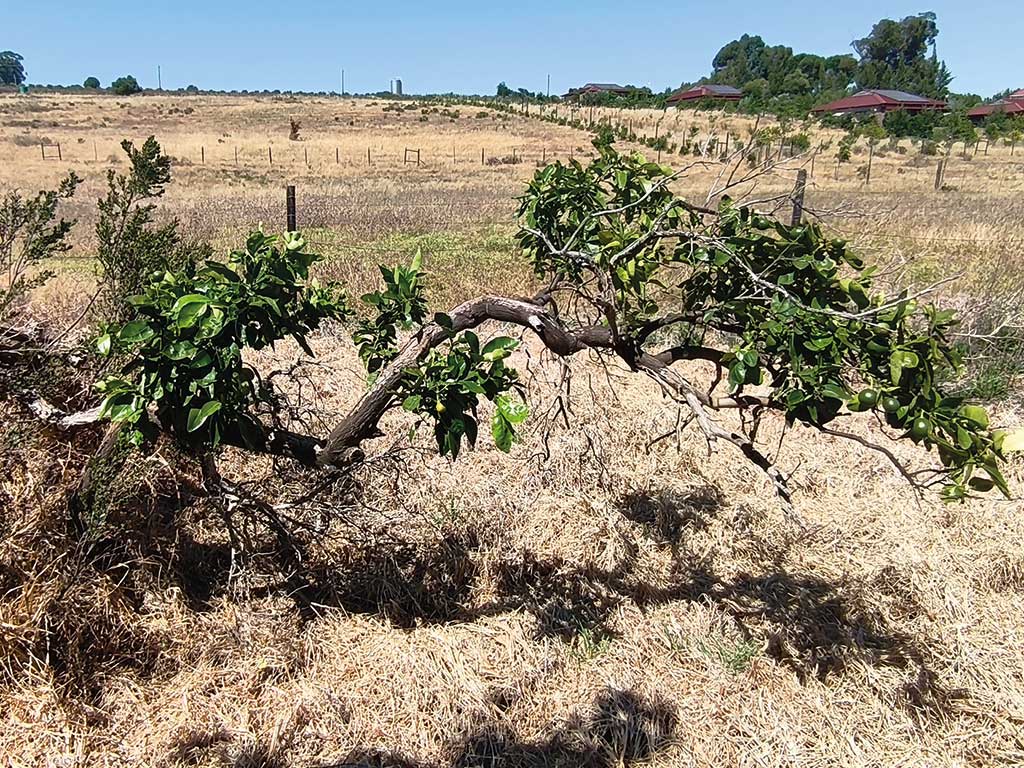
Three Marsh grapefruit trees have reached the remarkable age of 100 years.
Extension briefs by the Citrus Research International Extension Team.

CRI successfully hosted its annual Citrus Postharvest Workshops at the beginning of this year.
Extension briefs by the Citrus Research International Extension Team.

Citrus nurseries can become reservoirs for soil- and water-borne pathogens, especially Phytophthora species such as P. nicotianae and P. citrophthora.

Don’t let harvest mishaps turn high expectations into a costly nightmare.
Integrated pest management, Crop and fruit quality management, Grondgedraagde siektes, Water management/waterbestuur, Postharvest pathology – waste prevention checklist.

Citrus Research International (CRI) established a biosecurity division in 2016, with a mission to protect the Southern African citrus industry through timely identification of biosecurity threats; the development of preparedness; awareness, early detection, rapid response and impact mitigation plans; and ensuring effective application of the associated actions.

Pre-harvest monitoring for FCM infestation in citrus orchards is important in assessing FCM risk and the need for additional control measures. Particularly within a systems approach, it is important that such a system is reliable and accurate.
This study determined that both the originally used five-data-tree monitoring system and a newly developed system using a 100-fruit sample from sanitation fruit, are statistically reliable and accurate. The advantage of the new system is that it avoids a clash between the activities of the orchard monitoring and sanitation teams.
To determine the percentage of infested fruit, growers should scout regularly for mealybug by inspecting underneath calyces. Where mealybug is under good biocontrol, infestation should peak during December or January in the northern production areas, and during February in the Cape production areas.

Stink bugs (Pentatomidae), tip wilters (Coreidae) and seed bugs (Lygaeidae) belong to the order Hemiptera or sucking bugs. They are characterised by their piercing-sucking mouthparts, nymphs that look like miniature versions of the adults, winged adults, and the ability to produce noxious smells as a defence mechanism.