When is fruit ready to be harvested?
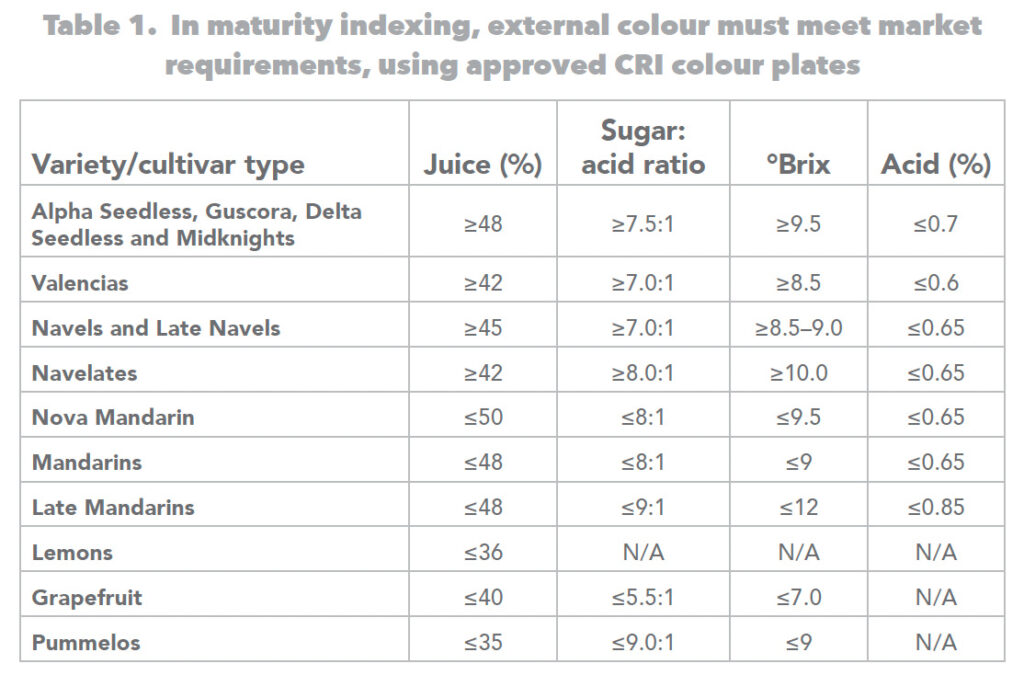
Maturity indexing is imperative (Table 1).
Harvest decisions must be driven by weekly maturity-index tests and objective standards. Fruit should only be harvested for export once specific minimums have consistently been met according to the Perishable Products Export Control Board (PPECB) standards, or stricter minimum market requirements.

When not to harvest – the five absolute red flags
Even when maturity indices are satisfactory, the following harvest conditions dramatically increase rind disorders and decay:
- Fruit still wet from rain, irrigation, or dew.
- Excessively high soil moisture levels, resulting in turgid oil glands.
- The fruit is too green (especially lemons and early navels).
- Within 10-14 days after a cold front.
- Ambient relative humidity >70 %.
If we ignore these guidelines, oleocellosis, peteca, or pitting symptoms could develop (Figures 1-3).
How to measure the ideal harvesting conditions
- Measuring fruit turgidity – the penetrometer is your best friend. The single most powerful tool for predicting oleo is the rind oil-release pressure penetrometer (Figure 5):
- Use the 8 mm probe for mandarins/soft citrus and the 6 mm one for oranges/lemons.
- Test 20-25 fruit per orchard on the shaded side.
- Safe harvest threshold: >3.0 kg. Readings below 3 kg indicate that the risk of oil glands bursting at the slightest touch is high – severe oleocellosis is thus inevitable.
- Testing the humidity – the sling psychrometer is a trusted tool. Whirl the sling psychrometer for 30 seconds and record the wet and dry bulb. Repeat these three times. Use the table provided to measure the humidity (Figure 4).
- Measuring the fruit rind temperature – thermometer. Insert the needle probe into the albedo of the fruit (Figure 5). The fruit rind temperature should always be 3°C higher than the wet bulb temperature of the sling psychrometer. Discard the punctured fruit.
- Measure the soil moisture with a soil auger. If the soil moisture content is too high, the tree will keep on absorbing the moisture, thus the fruit will remain turgid.
1: Oleocellosis lesions on lemons 2: Rind pitting on a Valencia orange 3: Characteristic peteca spot development on a lemon 4: Sling Psychrometer to test humidity 5: Use a thermometer to test fruit rind temperature
Harvesting do’s and don’ts – protecting fruit in the first 30 seconds of picking
- Clip stems – never snap pick.
- Prevent long stems in the bins.
- No long nails, no running with picking bags, do not over-fill picking bags or bins.
- Picking bags should be kept clean and free of sharp edges.
- Soft citrus bins: fill only halfway.
- Gently roll the fruit out of the picking bag into the bin.
- Never leave harvested fruit in direct sun or dry hot winds for extended periods, as this will dehydrate the fruit rind.
- Low-hanging and dropped fruit stay in the orchard. Don’t pick them – there’s no 30-second rule.
- Separate unmarketable fruit in the field (saves packing costs and reduces pressure on the pack house).
- Bins must be sanitised, cleaned, and free of sharp edges after every delivery to the pack house.
The cost of not considering the natural environment
The images we see every season are heart-breaking: perfect fruit rejected to waste by oleocellosis, peteca, pitting, and plugging. Markets in Europe, the UK, North America, and Asia have a minimum tolerance for rind defects. One careless week of harvesting can wipe out the profit of an entire block and damage customer relationships built over decades.
The citrus growers of SA, field teams, and pack house staff have ensured a season of pristine quality fruit in the orchard and pack house. Now it is up to every manager and contractor to carry that excellence across the “goal line”.
Follow these key principles below, and 2026 could be remembered as the season during which we didn’t just gain the hard metres – we grounded the ball emphatically under the posts.
- Respect maturity standards.
- Measure rind strength.
- Enforce handling discipline.
- Monitor the weather like a hawk.
Let’s finish each season as winners.
For more detailed guidelines, videos and the latest colour charts, visit www.cri.co.za or contact your regional CRI postharvest extension specialist.


