Centenarian milestone in citrus makes for unexpected discoveries. Louise Brodie and Irma Raspel report
As the South African citrus industry prepares to celebrate the centenary of the South African Cooperative Citrus Exchange, established in 1926, another quieter centenary is being marked in a corner of a Farm in Wellington’s district. There, three Marsh grapefruit trees have also reached the remarkable age of 100 years. Planted in 1926, these trees have survived in situ for a full century and continue to carry a story of unusual significance for the South African citrus industry.
Irma Raspel of Citrus Research International (CRI) recently visited the trees, accompanied by Professor Hano Maree of Stellenbosch University and CRI. Their visit highlighted the remarkable history of these old Marsh grapefruit trees and their importance in SA’s citrus plant improvement work
The exact origin of the Nartia (A Marsh grapefruit selection) trees remains obscure. They have traditionally been associated with budwood believed to have been imported into SA from California by Piet Cillié. A Wellington fruit pioneer, Cillié also became known as “Piet California”. However, while this connection is plausible, it remains a historical association rather than a fully documented fact.
The records state that the trees were already known to the citrus industry by the 1950s. Industry archives show that an extension officer of the South African Cooperative Citrus Exchange in the Western Cape reported the existence of these Marsh grapefruit trees. At the time, they were estimated to be approximately 30 years old and were described as performing well and being virtually free of stem pitting.
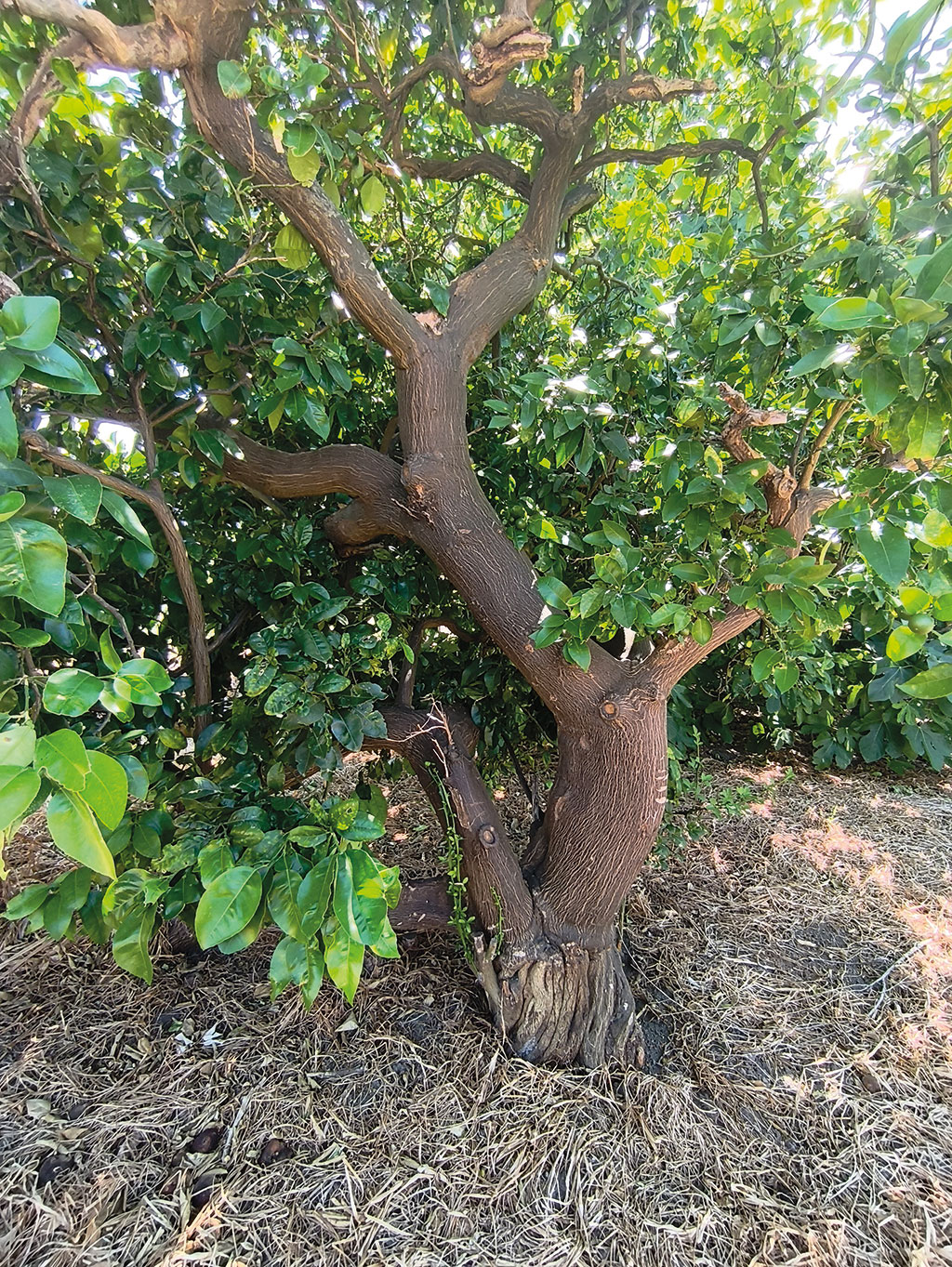
The healthiest and largest of the remaining trees
This observation would later prove significant. In 1972, the three trees, identified as Nartia A, Nartia B and Nartia C, were selected as budwood sources for the interim Citrus Improvement Programme, now the Citrus Improvement Scheme. They were found to be free of citrus viroids, apple stem grooving virus, citrus psorosis virus and Impietratura disease. Samples were taken again during the 1980s and ’90s. These samples were established in a glasshouse at the Agricultural Research Council (first collection) and CRI (second collection) – both in Nelspruit – headquarters for citrus tristeza virus evaluations.
Thus, the old Nartia trees became part of a much wider story of plant health, budwood selection and citrus improvement in SA.
During her inspection, Irma found that the trees are still growing, despite receiving no irrigation or fertiliser. The largest and strongest of the three remains healthy, with shiny, deep-green leaves and still bears fruit every year. This tree has a plate attached to it, though the writing is no longer legible.
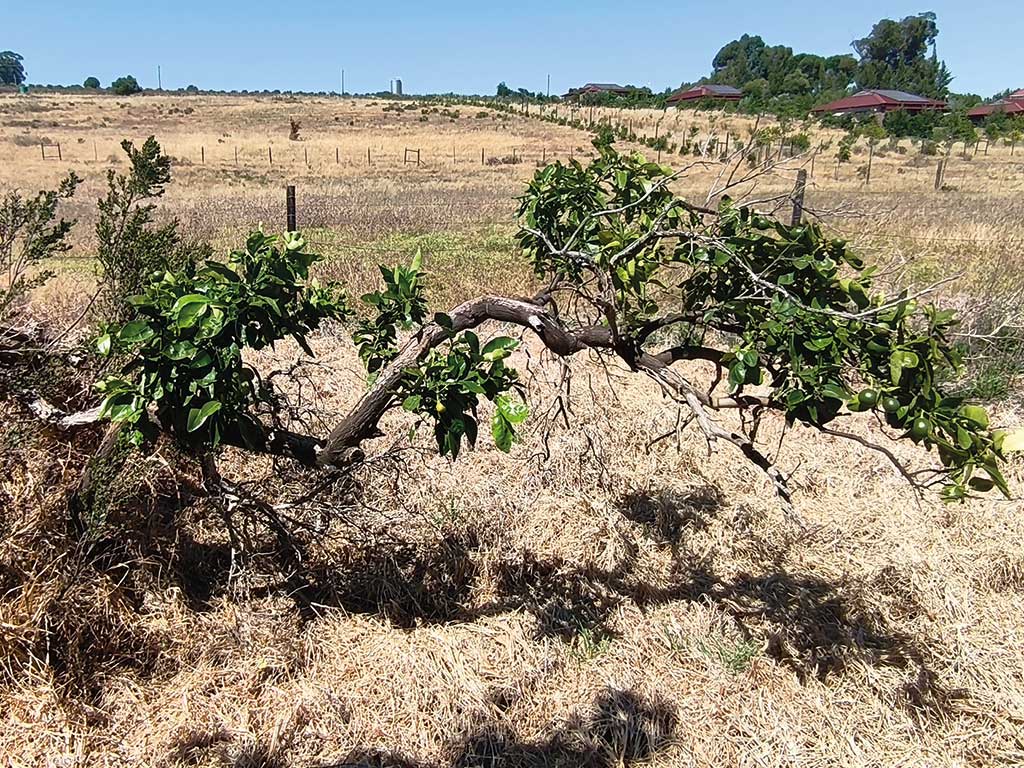
The other two trees are weaker, but still alive. One of them has fallen over, yet it continues to produce healthy new shoots. Their survival, with such limited care, adds to their value as living witnesses to a century of citrus history.
The farm owner and his children are aware of the significance of the trees. Each year, the family makes marmalade from the fruit of the strongest tree, continuing a simple but meaningful connection between the farm, the trees and their fruit.
These remarkable Marsh grapefruit trees have made an important contribution to the South African citrus industry. They have endured for 100 years, remained rooted in the place where they were planted, and helped inform important citrus plant improvement work over several decades.
A considerably smaller tree among the remaining ones
Irma recently had the opportunity to visit the trees again and to sample their fruit. The results were unexpected, as their taste is not typical of the usual Marsh grapefruit, which raises further questions about the origins of these remarkable trees. What remains clear, however, is that their continued survival is not only a horticultural curiosity. It is also a reminder that some of the most important stories in agriculture are still standing quietly in old orchards, waiting to be recognised.
Note that these trees are planted on private property and are not accessible to the public.Any person who wants to visit the trees can contact Irma Raspel at irma@cri.co.za.
We use cookies on our website to give you the most relevant experience by remembering your preferences and repeat visits. By clicking “Accept All”, you consent to the use of ALL the cookies. However, you may visit "Cookie Settings" to provide a controlled consent.
This website uses cookies to improve your experience while you navigate through the website. Out of these, the cookies that are categorized as necessary are stored on your browser as they are essential for the working of basic functionalities of the website. We also use third-party cookies that help us analyze and understand how you use this website. These cookies will be stored in your browser only with your consent. You also have the option to opt-out of these cookies. But opting out of some of these cookies may affect your browsing experience.
Necessary cookies are absolutely essential for the website to function properly. These cookies ensure basic functionalities and security features of the website, anonymously.
Cookie
Duration
Description
cookielawinfo-checkbox-analytics
11 months
This cookie is set by GDPR Cookie Consent plugin. The cookie is used to store the user consent for the cookies in the category "Analytics".
cookielawinfo-checkbox-functional
11 months
The cookie is set by GDPR cookie consent to record the user consent for the cookies in the category "Functional".
cookielawinfo-checkbox-necessary
11 months
This cookie is set by GDPR Cookie Consent plugin. The cookies is used to store the user consent for the cookies in the category "Necessary".
cookielawinfo-checkbox-others
11 months
This cookie is set by GDPR Cookie Consent plugin. The cookie is used to store the user consent for the cookies in the category "Other.
cookielawinfo-checkbox-performance
11 months
This cookie is set by GDPR Cookie Consent plugin. The cookie is used to store the user consent for the cookies in the category "Performance".
viewed_cookie_policy
11 months
The cookie is set by the GDPR Cookie Consent plugin and is used to store whether or not user has consented to the use of cookies. It does not store any personal data.
Functional cookies help to perform certain functionalities like sharing the content of the website on social media platforms, collect feedbacks, and other third-party features.
Performance cookies are used to understand and analyze the key performance indexes of the website which helps in delivering a better user experience for the visitors.
Analytical cookies are used to understand how visitors interact with the website. These cookies help provide information on metrics the number of visitors, bounce rate, traffic source, etc.
Advertisement cookies are used to provide visitors with relevant ads and marketing campaigns. These cookies track visitors across websites and collect information to provide customized ads.