![Adobestock 304939150 [converted]](https://www.safj.co.za/wp-content/uploads/2024/09/AdobeStock_304939150-Converted.jpeg)
Extension briefs february and march 2026
By Hannes Bester, MC Pretorius, Wayne Mommsen, Coenraad Fraenkel, André Combrink, Natasha Jackson, Jan Landman, Rudolph Strydom, Irma Raspel, and Vernon Jacobs (Citrus Research International)
Integrated pest management
Mealybug (S.D. Moore)
To determine the percentage of infested fruit, growers should scout regularly for mealybug by inspecting underneath calyces. Where mealybug is under good biocontrol, infestation should peak during December or January in the northern production areas, and during February in the Cape production areas. If mealybug infestation does not decline by the end of January in the northern regions or by March in the Cape production regions, two corrective actions may be considered, separately: (1) Release of the coccinellid predator Cryptolaemus montrouzieri at a recommended density of 1 000–2 000 beetles/ha, (2) Application of sulfoxaflor (e.g., Closer), spirotetramat (e.g., Tivoli) and fenpyroximate (e.g., Lesson), the former two being the most effective. The chemical options may not have a specific corrective registration, but their withholding periods do permit late-season use. Although registered, methomyl is not a preferred option, as it is not effective at the dose generally registered for mealybug, and methomyl is the only registered corrective option for red scale. It would be wise to restrict corrective usage to red scale alone, so the onset of resistance is not expedited. Ensure compliance with the pre-harvest interval of any product used. Another very important consideration in achieving and maintaining good mealybug control is diligent exclusion of ants from the tree canopy.
The species of mealybug present should also be determined, as it appears that the biocontrol complexes of mealybug species other than citrus mealybug, might not be as effective as that of citrus mealybug. Therefore, treatments can be applied more readily when other species are identified as being dominant. The phytosanitary status of certain species must also be borne in mind. Note that colour plates and a key for identification of the different mealybug species are available to order from Citrus Research International (CRI). Please also bear in mind the molecular mealybug identification service offered by the CRI diagnostic laboratory in Nelspruit, and the Plant Health Diagnostic Laboratory of the Department of Agriculture in Stellenbosch.
A mealybug infestation can also attract a carob moth infestation. Therefore, if the fruit are to be exported to a market that is sensitive to carob moth, mealybug must be effectively controlled well before harvest. Finally, if the fruit are to be exported to a mealybug-sensitive market, clear guidelines for pre- and postharvest management – as provided in Cutting Edge 298 – must be followed. This includes stringent inspections, with zero tolerance for infestation with any quarantine species.
False codling moth (S.D. Moore)
All growers intending to export to Europe should be fully compliant with the False Codling Moth Systems Approach (FCMSA) for export of citrus to the EU and, consequently, the Good Agricultural Practices (G.A.P.) described in CRI’s Production Guidelines for the Control of FCM on Citrus. For phytosanitary reasons, false codling moth (FCM) must be controlled throughout the season to as close to a non-detectable level as possible, using a combination of orchard sanitation and various effective registered control measures. Weekly monitoring of fruit infestation, as described in the FCMSA, will provide an accurate indication of the efficacy of the control programme and the level of compliance amongst the export (shipping) options described in the FCMSA. These sprayable insecticides are registered and available for use against FCM: the granulovirus products (Cryptogran, Cryptomax, Cryptex and Gratham), Methoxyfenozide (several trade names), Delegate, chlorantraniliprole (Coragen, Cordial), emamectin benzoate (Warlock, Emperor, Conflict Granule), Broadband, Eco-Bb, Mycoveria and Metacide [the last four being entomopathogenic fungi (EPF)], ensuring compliance with market-specific restrictions. The granuloviruses and EPF can be used up until the day of harvesting. However, according to label recommendations, the EPF are not suitable corrective options for FCM. Thus, they are not listed as such by PhytClean. A virus application should be applied shortly after a peak in FCM activity, determined by the use of a pheromone trap. However, this may be difficult to determine late in the season when FCM levels are low and generations are overlapping.
Methoxyfenozide, Delegate and chlorantraniliprole are all registered to be applied once or twice per season and all have withholding periods of 30 days or less for most markets. Emamectin benzoate has a 14-day withholding period and can be applied at seven- to 10-day intervals (Warlock, Emperor) or 14-day intervals (Conflict Granule), if required (refer to label registration). Therefore, these products are suitable for a final application against FCM before harvest. It is strongly recommended that they should not be applied later than three to five weeks before harvesting begins. Other chemical options are triflumuron (Alsystin), teflubenzuron (Nomolt), fenpropathrin (Meothrin and others) and Cypermethrin. However, there are some difficulties associated with these products, such as prohibitive maximum residue levels (MRLs) for certain markets, development of resistance by FCM, or secondary pest repercussions. Hence, they are not preferred as options for FCM. Mating disruption products additional to the insecticides are Isomate, Checkmate, Splat and X-Mate – and Last Call FCM (an attract-and-kill product). For optimal efficacy, start using these products early in the season, while FCM levels are still low. As the weather cools towards autumn, these pheromone-based products may become less effective due to a reduced release rate. In such a case, it may be necessary to follow up these treatments with a spray for FCM.
Fruit fly (A. Manrakhan)
Fruit flies are pests of phytosanitary concern. There is zero tolerance for fruit fly eggs and larvae in fruit consignments for export. The fruit fly pests affecting citrus are Ceratitis capitata (Mediterranean fruit fly or Medfly), Ceratitis rosa (Natal fly) and Bactrocera dorsalis (Oriental fruit fly). The latter is present in the provinces of Limpopo, Mpumalanga, North-West, Gauteng and KwaZulu-Natal (excluding the magisterial districts of Amajuba, uMgungundlovu, uMzinyathi, uThukela and Zululand) and in Sundays River Valley in the Eastern Cape Province. For export of citrus to the EU, growers must implement the Citrus Fruit Fly Management System (Citrus FF-MS) that consists of two Fruit Fly Systems Approaches: one for lemons and limes (Citrus FF-SAL) and one for other citrus types (Citrus FF-SAO). For both Citrus FF-SAL and Citrus FF-SAO, PhytClean registration is as prescribed by the FMS. In Citrus FF-SAL there are two independent measures that mitigate the risk of fruit flies: (1) non-host status of commercial export-grade lemons and limes for fruit fly pests of citrus and (2) Perishable Products Export Control Board (PPECB) phytosanitary inspections of fruit packed for export. In Citrus FF-SAO there are three independent measures that mitigate the risk of fruit flies: (1) Fruit Fly Good Agricultural Practices (FF G.A.P.) with Packhouse Delivery Inspections as the endpoint, (2) packhouse grading and PPECB phytosanitary inspections of fruit packed for export and (3) postharvest shipping conditions as determined by the FMS. FF G.A.P. consists of two components: monitoring and pre-harvest control. Monitoring of all fruit fly pests of citrus should be carried out using registered traps, as recommended in the CRI Production Guidelines. Thresholds exist for all registered trapping systems and these should be adhered to, particularly when fruit is susceptible to attack (at and after colour break). The threshold levels in all registered trapping systems are provided in the CRI Production Guidelines. Monitoring of Oriental fruit fly per production unit code (PUC) is a requirement for phytosanitary registration of citrus for export to special markets (the US, Japan, South Korea, China and the EU).
Bud mite (D.L. Saccaggi)
An assessment of blossom, twig and leaf malformation due to bud mite should be conducted yearly as part of routine orchard inspection. This is especially important on non-bearing trees, where malformations can permanently stunt growth. An increase in malformation from the previous year’s scouting data should trigger corrective action. If corrective action is needed, then a bud mite spray should be applied between February and May. This timing is critical, because this is when bud mites cause damage to the following season’s growth. It is also important to note that application of a pesticide will have no effect on damage levels in the current season, but will protect the growth and blossoms of the following season. If it is not possible to apply a pesticide between February and May (e.g. too close to harvest), then continue to suppress mite populations throughout the year.
In orchards with a history of bud mite infestation, particularly those with susceptible cultivars like lemons, it may be necessary to apply a preventative bud mite spray annually, regardless of whether malformations are seen during orchard assessment. The timing of this should also be between February and May to protect the following season’s growth. If done properly, corrective action should be taken before bud mite infestation levels are high enough to cause significant fruit malformation and crop losses. Severe levels of fruit malformation should not be seen in a well-managed orchard.
Fenpyroximate (Lesson, Mitigate or Pyromite) is commonly used against bud mite, as it has a slight fumigant property that enhances its penetration into the buds. For late cultivars, a fenpyroximate spray may not be possible due to the long pre-harvest interval. In these cases, continuous suppression of mite populations throughout the year is necessary. Other acaricides registered for bud mite include abamectin, acephate, amitraz, bromopropylate, etoxazole, fenpropathrin and methamidophos. Many of these are also effective against other mite or insect pests. Ideally, corrective action should be taken before bud mite infestation levels are high enough to cause significant fruit malformation and crop losses. A a well-managed orchard should not have severe levels of fruit malformation.
Green citrus leafhopper
A. Manrakhan and S. Hansen
Green citrus leafhopper, Empoasca distinguenda, occurs in most citrus producing regions in SA. Leaf damage and sooty mould production are usually not of economic importance. However, just one green citrus leafhopper can lead to significant fruit damage on a tree. Fruit becomes susceptible after colour break. Navel oranges, and especially some mandarin cultivars, are particularly susceptible. Lucerne, potatoes, legumes and pecans are alternative hosts for green citrus leafhopper. Lucerne should not be planted close to citrus orchards, as disruption (through mowing) will cause the leafhoppers to move into orchards. Some broadleaf orchard weeds can also host leafhoppers, and the drying/control of these weeds during/after colour break can cause the leafhoppers to move into trees.
Monitoring can be conducted with three yellow sticky traps/ha, diagonally distributed through the block. The treatment threshold for green citrus leafhopper is five/trap/week. This method can be supplemented by branch shaking, which agitates adult green citrus (and other) leafhoppers to take flight. Pymetrozine (Chess) and Xterminator are registered for leafhopper control. However, for orchards being prepared for export to the EU and many other markets (CODEX A, CODEX B, USA and Japan), pymetrozine cannot be used. Although not registered, late season use of methomyl or mevinphos, targeted against other pests, will simultaneously control green citrus leafhopper.
Grondgedraagde siektes
J. van Niekerk en MC Pretorius
Grond- en wortelmonsters behoort elke drie jaar geneem te word om sodoende die sitrusaalwurm- en Phytophthora-status in sitrusboorde te bepaal. Resultate sal dien as ’n bestuurshulpmiddel wat gebruik kan word om grondpatogene effektief te beheer.
Phytophthora bruinvrot/wortelvrot
Weens die gevaar van fitotoksisiteit op gevoelige sitruskultivars tydens hoë temperature wat gedurende Februarie/Maart kan voorkom, moet die gebruik van fosfonaatblaarbespuiting streng volgens die etiket geskied (geen sagtesitruskultivars behoort weens hul gevoelige skille gedurende hierdie tyd van die jaar met hierdie produkte gespuit te word nie). Hoë dagtemperature, tydelike vogstremming en warm bergwinde kan veroorsaak dat fosfonate swart stippeltjies soortgelyk aan koperskade, op vrugte veroorsaak. Bome moet daarom nie gespuit word as toestande nie optimaal is nie. ’n Wortelvrotbeheerprogram (blaarbespuiting) sal bruinvrot ook effektief kan beheer. Bruinvrot ontwikkel slegs wanneer die klimaatstoestande gunstig is vir die patogeen (Phytophthora) om te infekteer en te ontwikkel. Voorkomende fosfonaatblaarbespuitings is dus nie nodig in droë najaar met geen – of slegs ligte – reënbuie nie. Indien dit egter nat najaar is, kan bome met kontakmiddels soos koper of mancozeb (let op beperkings na markte) asook sistemiese produkte soos fosfonate (let op etiket-aanbevelings vir weerhoudingstydperk en waarskuwings) gespuit word om bruinvrot te beheer. Bo en behalwe droogte en hitte, kan oormaat vogtige toestande (baie reën) ook bome onder tydelike verwelkte toestande plaas wat gevaar vir blaarbespuitings inhou. Bome moet dus nie tydens of kort ná sulke toestande gespuit word nie. Laastens beïnvloed drag ook boom se gevoeligheid vir droogtespanning. Hoe hoër die drag, hoe gevoeliger is die boom vir uitdroging en hoe groter is die risiko vir fitotoksisiteit.
Sitrusaalwurm
Wortelmonsters kan enige tyd van die jaar getrek word om die status van die sitrusaalwurmpopulasies in boorde te bepaal. Wyfietellings word gebruik om te bepaal of die toediening van ‘n aalwurmdoder geregverdig is. Die drempelwaarde voordat ‘n aalwurmdoder oorweeg word is 1 000 wyfies/10 g wortels. Daar word aanbeveel dat aalwurmdodertoedienings ’n aanvang neem tydens die begin van die reënseisoen. Dit sou daarom die regte tyd wees vir produsente in die Wes-Kaap om hulle aalwurmmonsters in Maart te trek, sodat hulle weet watter boorde om te behandel wanneer die winterreëns begin.
Residuweerhoudingstydperke moet in ag geneem word. Dit is belangrik om ‘n aalwurmbeheerprogram te volg soos op die produk-etiket aangedui, ten einde optimale onderdrukking van die aalwurmpopulasies te verkry. Tydens die toediening van aalwurmdoders is dit uiters belangrik dat ten minste 40 mm besproeiing daarna toegedien word. Dis om te verseker dat die middels in die grondprofiel ingewas word. Die meeste aalwurmdoders loog baie stadig. Die effektiwiteit van die middels word dus belemmer indien hulle nie behoorlik deur die wortelsone versprei word nie. Geen aalwurmdoder behoort deur drupbesproeiingsstelsels toegedien te word nie. Indien toedienings in boorde met druptoediening gedoen moet word, behoort die middels as bandplasing (halwe meter aan beide kante van die drupperlyn) óór die drupperlyn gedoen te word. Dit kan wel deur mikro-besproeiingstelsels toegedien word. Indien daar beplan word om boord te verwyder, behoort aalwurmmonster en Phytophthora- grondmonster geneem te word voordat die boord verwyder word. Dis om te bepaal of sitrusaalwurms en Phytophthora spp. teenwoordig is. Dit dien as bestuursriglyn om ’n geskikte onderstam en berokingsmiddel te kies in gevalle waar herplantstrategie uitgewerk moet word.
Citriculture
Fruit production and quality
P.J.R. Cronjé
Internal quality If properly timed, regulated deficit irrigation can result in increased total soluble solids (TSS) and an increase, or no response, in titratable acidity. Regulated deficit irrigation, imposed in the last two months prior to harvest, also enhances the rate of colour development. Deficit irrigation retards the breakdown of acid and can influence the solids:acid ratio at harvest for better or worse, depending on cultivar characteristics. It is mainly aimed at early cultivars like Satsuma. But other early-maturing cultivars with low internal quality could also benefit. Less water is applied, and at longer intervals. Therefore, irrigation is continued, but at a reduced level. Trees should be irrigated lightly two weeks prior to harvest. No water stress should be imposed during the initial growth phase of the fruit, i.e., during and after flowering. Some water stress (e.g., up to 50% extraction of available water) can only be allowed during the final maturation phase, i.e., the last two months prior to harvest (January for Satsuma). Any water stress earlier than the end of January could lead to reduced fruit size and loss of rind integrity. In high rainfall areas, regulated deficit irrigation may not be successful. The deficit should be imposed slowly, so that the trees can adjust without symptoms of drought. Sudden water stress can have adverse effects on tree health, fruit size and fruit quality. Management of this technique is much easier when trees are planted on ridges and when the right scheduling equipment is used. In high rainfall areas, application of regulated deficit irrigation may, however, not be possible.
Maturity indexing should commence on early cultivars like Satsuma. Maturity indexing is done to predict the rate of change in fruit maturity, to harvest fruit at optimal maturity and to maintain acceptable commercial shelf life. The aim is to define changes or the rate of change in acids and sugars, and to build up a database over several years for comparison. Random sampling of fruit every week from each of 10 representative trees should start four to six weeks before the expected harvest date. Titratable acidity is determined by titration with sodium hydroxide. Sugar content (Brix) is determined using a refractometer, the sugar:acid ratio calculated and fruit colour should be read from a colour chart. All the parameters mentioned above should be plotted on a graph over time. Once plotted, trends will become apparent, harvest dates can be estimated, and problem areas in internal and external quality parameters can be identified and manipulated.
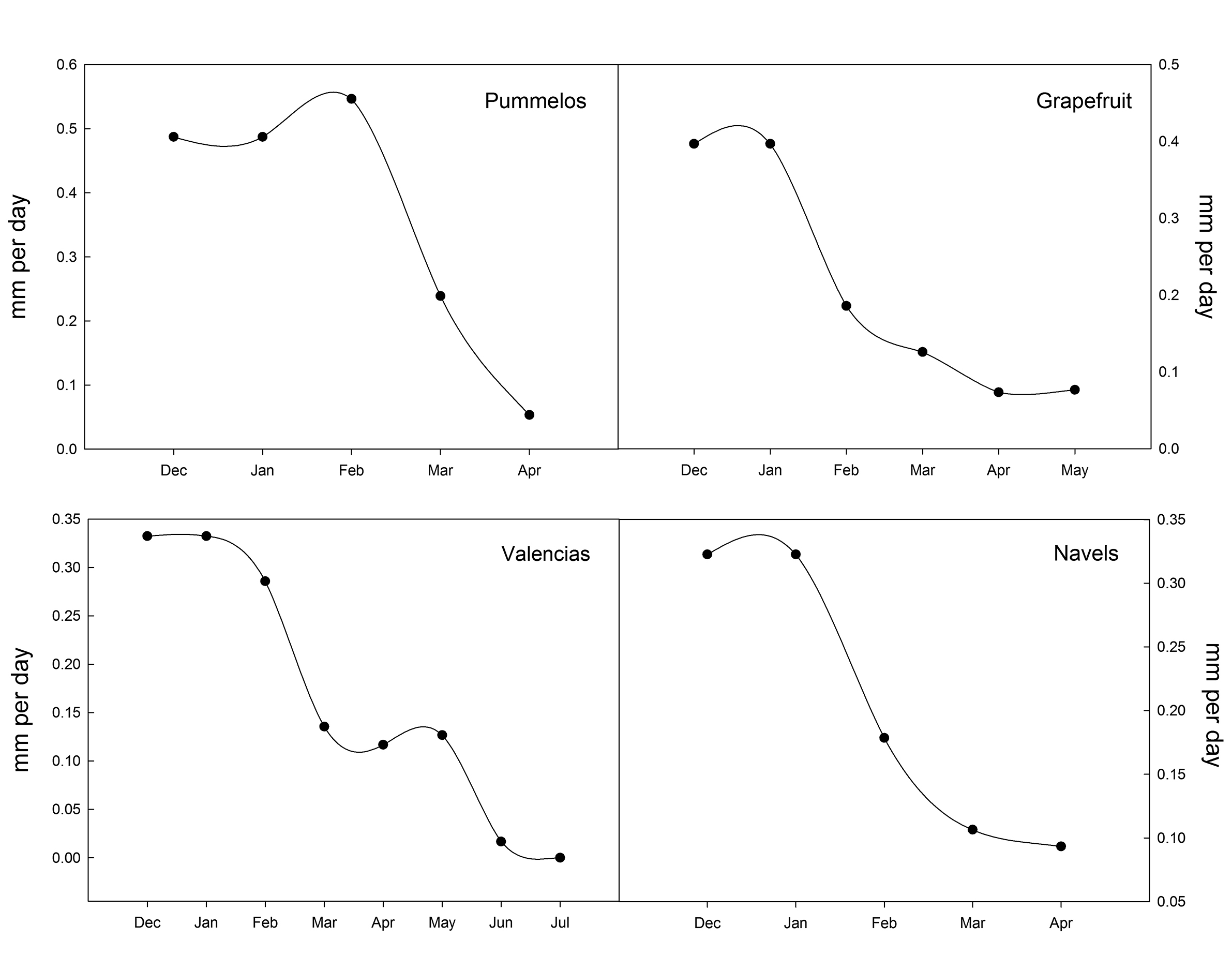
Fruit growth and size during this time are important to achieve the optimum size at harvest. Fruit growth is in the peak of phase II, in which most fruit size increases take place for most cultivars (Figures 1 and 2). Ensure optimal irrigation and try to avoid stress conditions, as this might have an adverse effect on fruit size. Fruit thinning plays a critical role in fruit size (see Cutting Edge no. 32: Fruit size improvement). And correct pruning practices are the most effective way to manipulate the number of fruit per canopy volume and the eventual fruit size. For more information, refer to the SA Fruit Journal Oct/ Nov 2015: The reproductive phenology of Citrus III: Morphogenesis from flower to fruit.

Regrowth control should be done, especially after heavy pruning earlier in the season. A lot of regrowth adversely affects fruit size and is antagonistic to fruit colour development, particularly for early-maturing cultivars.
Oleocellosis dictates that late summer vegetative growth of bearing trees be kept to a minimum. Excessive vegetative vigour during this period is associated with high incidence of oleo at harvest. Rind colour development is hindered by late nitrogen application and the use of high concentrations of heavy summer oil sprays after January.
 Geïntegreerde bemesting/integrated fertilisation
C. Fraenkel and P. Raath
Neem van blaar- en grondmonsters, onderskeidelik in die periodes van Februarie–April en Maart–Junie, moet gebruik word vir jaarlikse blaar- en grondontledings. Blaarmonsters behoort jaarliks geneem te word, terwyl grond elke twee tot drie jaar gemonster kan word, afhangende van grondtekstuur. Omdat die waarde van die ontleding geheel en al afhang van die mate waartoe die monster die blok se voedingstatus verteenwoordig, moet baie moeite gedoen word met die monsternemingsproses. Standaardiseer die monsternemingsprosedure.
Monster blare elke jaar
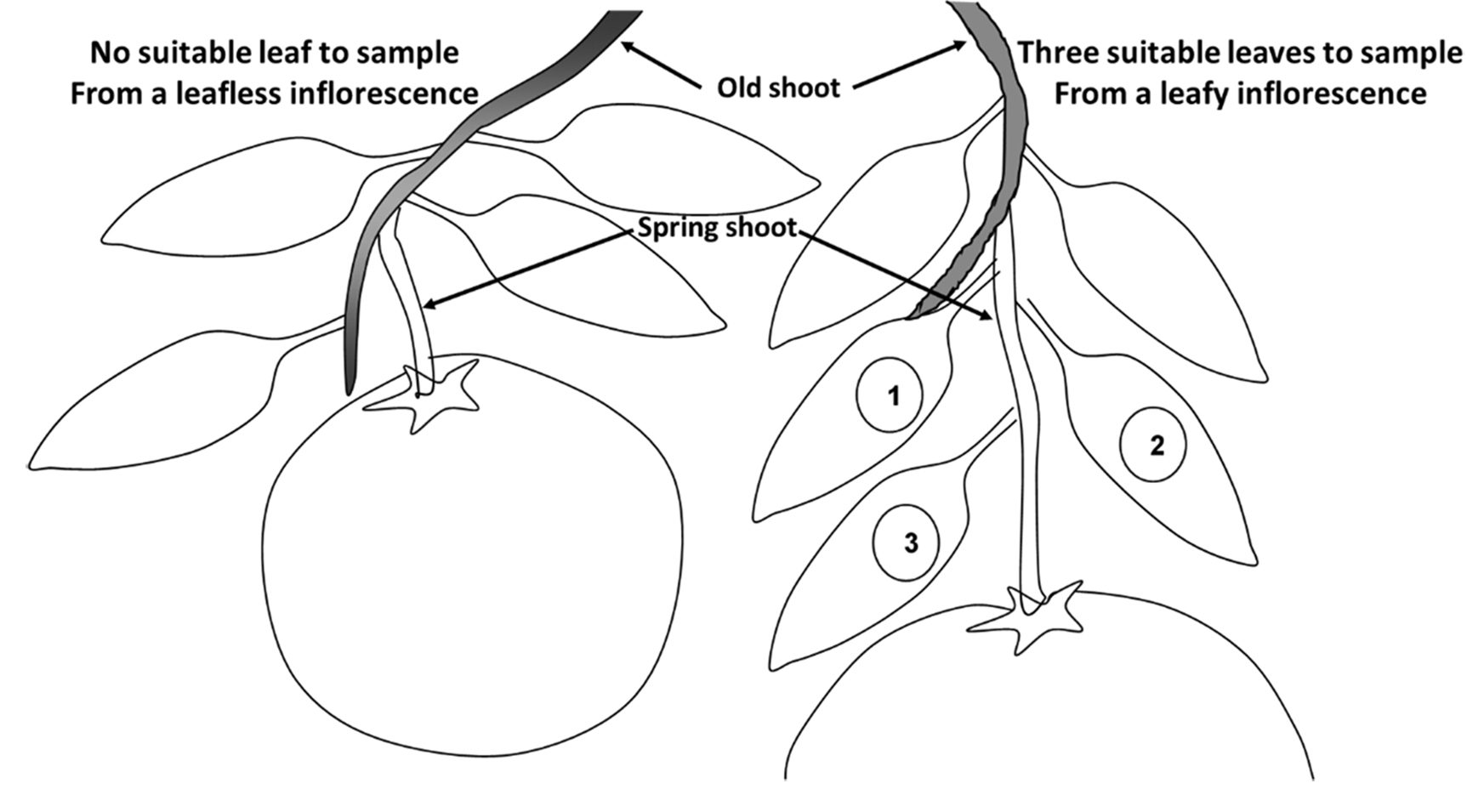
Aanbevole monsterprosedures is dus as volg: Vrugdraende bome: Kies een (lang) tot twee (kort) rye wat verteenwoordigend is van die boord. Indien die boord 5 ha of groter is, kies dan een (lang) of twee (kort) rye per 5 ha. Hierdie rye behoort permanent gemerk te wees en verkieslik ook gebruik word as die rye waarin grondmonsters versamel word. Stap af met die ry aan een kant (oggendson kant) en terug aan die ander kant (agtermiddagson kant), terwyl tussen 75 en 100 blare (per monster) op heup- en kophoogte geneem word.
Monster elke jaar vanaf Februarie tot April, maar altyd tydens dieselfde week of periode, bv. einde Februarie of week 10. Blaarmonsters wat gedurende Junie en selfs Julie geneem word, is steeds bruikbaar, maar dan is daar baie min tyd oor om bemestingsprogramme voor te berei. Pluk slegs blare van lote met ’n terminale vrug.
Vir vroeë kultivars wat reeds ge-oes is, bepaal die posisie waar die vrug tydens oes afgesny is (die stingel bly agter). Volg dan dieselfde monsterprosedure. Ideaal behoort monsterneming voor oes gedoen word.
Nie-draende bome: Gebruik dieselfde prosedure om indikator-rye te selekteer. Neem 75 tot 100 blare per monster van respektiewelik oggend- en agtermiddagson kante, deur nie meer as twee blare per boom te neem nie. Pluk een van die blare genommer 5–7 vanaf die lootpunt.
Monster, soos vir vrugdraende bome, ook gedurende laat somer en voorts gedurende dieselfde week elke jaar.
Sample soil at least every three years
For maintenance fertilisation, samples should be taken at least once every three years. Orchards with sandy or rocky soils, which can be subject to significant leaching, must be sampled at least every two years. Since soil chemical composition can differ significantly over short distances, long-term trends can only be monitored if samples are taken in the same area every time. Index rows should therefore be marked for this purpose, and it is wise to use the same rows for leaf sampling. Poorly performing sections should be sampled separately.
Due to dramatic chemical variation that can occur over depth, especially for soil pH and phosphorus (P) concentration, samples should always be taken at predetermined depths that are always the same. In this way, a history of results can be generated that can be correlated with fertilisation applications. Given the fact that lime applications and P fertilisation often do not react rapidly, it is preferable that samples be taken at a depth of 0–300 mm in the root zone, which is the depth on which calculations for maintenance application of ameliorants in established orchards are based. Deeper sampling is therefore unnecessary.
Note that the sampling procedure differs according to the type of irrigation used:
Micro-irrigated orchards Leaves and other debris must first be scraped away, but not the topsoil. Sampling must be done between the trunk and edge of the leaf canopy, where the most roots occur.
For soils that are not too hard or rocky, a soil auger or spade can be used. Take 10–15 sub-samples from positions that are evenly distributed down the length of the index row, sampling between the trunk of the tree and the edge of the canopy.
When the soils are hard or rocky, dig 40 cm-deep profile pits (3–5 pits), evenly distributed down the index row. Each profile pit is dug underneath a single tree, between the trunk of the tree and the edge of the canopy, as mentioned. Note the position of the pits so that the next samples (in two to three years’ time) are not taken at the same positions. Then remove a uniform strip of soil (10 cm wide, 3 cm into the profile wall) from the soil surface down to the end of the main concentration of feeder roots, up to 30 cm deep.
Take one sub-sample per index tree and put all sub-samples in a 20 plastic bucket. Once all of the sub-samples from the orchard have been collected, mix the soil thoroughly and use about 1 kg, as representative of the composite sample in the plastic bucket. Ensure that the bag is marked clearly with the orchard number and the depth of the sampling. Orchards with drip irrigation Follow the same procedure as for orchards with micro-irrigation, but the sample must be taken (1) from a dripper between the tree trunk and the edge of the canopy of the tree, and (2) between the dripper and the outer rim of the wetted zone.
Sampling rocky soil In soil where many stones or rocks are so large that they cannot be included in the sample, an estimation of the rock volume percentage must be done in the profile. This important information can have a significant effect on the ameliorant recommendation, and because rock in the profile reduces the actual volume of soil to be corrected. If the rock percentage is not considered, it will lead to an over-estimation of the ameliorants (gypsum, lime, potassium, phosphorus), causing imbalances in the soil.
Interpretation of leaf analyses
Leaf analyses are an indicator of the nutritional status of the trees. There is an established relationship between the concentration of the nutrient elements in the leaves and tree performance. The goal should be to achieve a plant nutrient status that falls within the optimal range for each nutrient.
Interpretasie van grondmonsters
Grondontledings verskaf inligting wat help om te besluit watter stappe geneem kan word om tekorte, wanbalanse en oormate in die voedingstatus van die bome reg te stel. Ongelukkig word interpretasie van die chemiese resultate dikwels gekompliseer deur die verskeidenheid ekstraksie-metodes en maniere waarop resultate uitgedruk word. Interpretasie van grondontledings moet dus met begrip van die ekstraksie-metodes gedoen word.
Postharvest pathology – prepacking pointers
W. du Plooy
Orchard sanitation: Sanitation is of crucial importance just before picking season starts. This practice is key for reducing fungal spore load, as well as keeping FCM and fruit fly under control. Orchard sanitation involves removing all fallen, decayed and injured fruit (including those on the trees) from the orchard and then burying or macerating the fruit. For macerating, the fruit should be cut into fine pieces and allowed to dry in the sun away from the orchards and packhouses. Fallen and injured fruit removed from the orchard can also be used as animal feed. Remember to follow the FMS guidelines and examine a sample of the sanitation fruit if you export to the EU. The FMS can be found on the CRI website under “Member downloads” and all changes will be communicated via the CRI Cutting Edges.
Skirt trees for sour rot and brown rot control: Ensure that trees are adequately skirted before they start bearing. This prevents low-hanging fruit, especially for heavily laden trees where fruit will be touching the ground or be within range of water splash. The practice will reduce the risk of Phytophthora brown rot infection during the rainfall season as well as sour rot (Galactomyces spp.) infection. Keep in mind that no pre-harvest fungicides are available to adequately control sour rot, so orchard sanitation and skirting are crucial. Remove dead wood from all citrus trees to reduce the spore load of the latent citrus pathogens.
Prevent injuries: Ensure that picking teams are trained to focus on preventing injuries. Avoid snap picking, unless pickers have mastered the technique, and the fruit is not to be exported. Injuries are the number one cause of postharvest decay. Keep in mind that some markets may be stricter on the stem-end length, so ensure pickers cut the stem end as short as possible, without damaging the rind.
Packhouse sanitation: Thoroughly clean the entire packhouse building and line before any fruit is brought to the packhouse in the new season. Use an appropriate sanitiser to clean everywhere from the roof to the floor, including walls and hard-to-reach nooks and crannies.
- Never allow any fruit – and more importantly, any fungicide-treated fruit – to lie around in the packhouse at any stage during the packing process.
- Spray the packhouse regularly with sanitisers, and immediately after finding even just a single rotten fruit.
- Constantly monitor concentrations of sanitisers in dump tanks, sprays, rinses, etc., and ensure that these sanitisers are being used according to the correct specifications (e.g., pH).
- Wash equipment such as trailers and/harvesting bins with a suitable sanitiser before they leave for the orchard.
- Ensure that packed cartons are cooled as soon as possible to prevent decay development.
- Store retention samples for each consignment and check them regularly for waste and other developing factors, such as pitting, rind breakdown and latent pathogens. Keep track of other defects such as damage by wind, thrips and mechanical damage.
Selection of fungicides: For many packhouses, the chemicals that will be used during the upcoming season are being sourced and negotiated. Decide on a chemical programme that is in line with decay control and export market regulations. Make use of the CRI Postharvest Factsheets that are available online at www.citrusres.com under “Member downloads”. If using a new product, ensure that it is safe for use (possible phytotoxicity; MRL restrictions) and that it is applied correctly. Also, keep in mind the cleaning protocol that must be followed if you need to strip the line of residues that has been used but is no longer allowed. See Cutting Edge No. 314, published by CRI, available on www.citrusres.com. Considering the increased cold-temperature shipping and FMS protocols, it is important that packhouses use thiabendazole (TBZ) for all fruit being exported. TBZ applied in the wax provides protection against chilling injury and helps control latent pathogen infections. A high solid wax (20–22%) will also aid in preventing chilling injury.
Related Posts
Extension briefs October and November 2026
By the Citrus Research International and Integrated Pest Management teams.
Extension briefs August and September 2026
Extension briefs by the Citrus Research International Extension Team.