New options and recent results
Van Wyk walked the audience through a summary of trial results for the main rootstocks (Atlas, Cadaman, Flordaguard, GF 677, Guardian, Kakamas, Marianna, SAPO 778, and Viking) available to South African plum, peach, and nectarine growers.
This information is shown in Table 1.
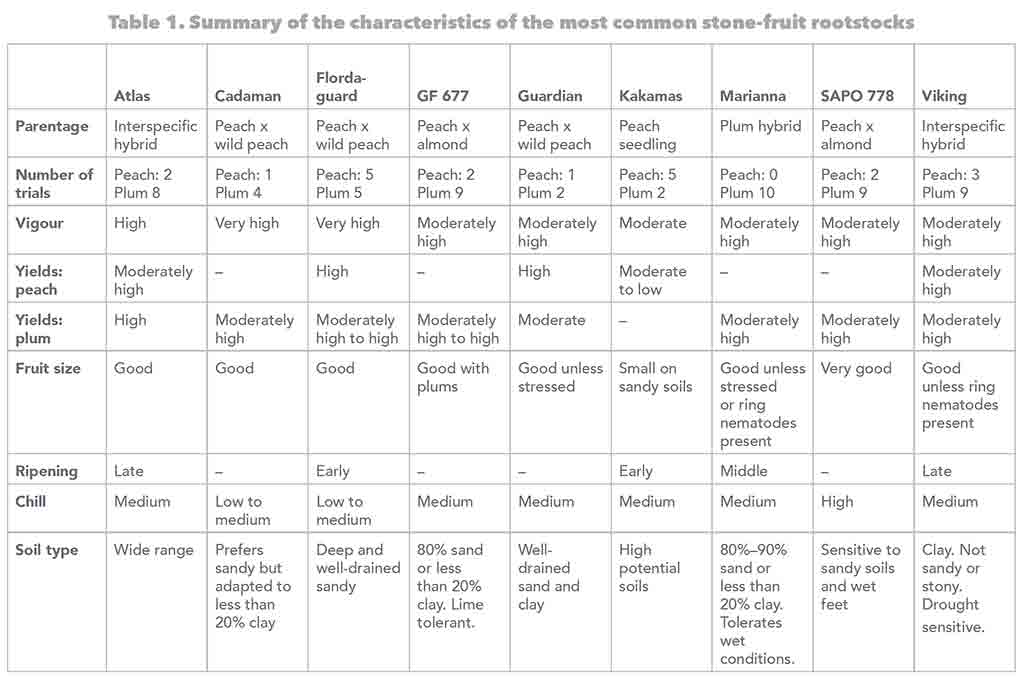
For more detailed rootstock tables, featuring 15 cultivars, including Barrier, OSM 99-3, and Rootpac-70, please refer to the June | July 2024 SA Fruit Journal.
“In terms of new rootstock cultivars, there are roughly 20 that could be included in trials,” said Van Wyk. “The first of these is Barrier, from the University of Bologna in Italy. It was included in one trial at Slanghoek, where its yields were second only to Guardian, but Barrier is vigorous.”
The Rootpac series from the Spanish Agromillora Group is represented in current trials by Rootpac 17, 19, and R, where the R stands for replant. Rootpac T, a low-chill clone of Flordaguard, will be included in new trials, as will rootstocks from the University of California’s Controller series.
Van Wyk also mentioned the OSM and OSK series, developed by the Agricultural Research Council (ARC) at their Simondium breeding facility, and the brand-new Spanish Provedo series. So, growers can look forward to even more rootstock options in the coming years.
How to choose a rootstock
Van Wyk discussed four categories of factors to consider when choosing a rootstock: scion-rootstock compatibility, soil and environment, pest and disease resistance, and orchard management.
“Genetic compatibility between the scion and the rootstock will become very important over the next few years,” he said. “Going forward, this will be one of the major questions, especially as new cultivars come into play.”
Growers should also think about chill requirement and rootstock-scion synchronisation. For example, when a low-chill scion is grafted on a high-chill rootstock in a warm region, the scion may come into growth while the rootstock is still dormant and unable to supply water and nutrients to developing blossoms and leaves.
Hortgro-funded research has shown that correctly matching the cultivar and rootstock to the production region’s chill can more than double yields.
The preference of different rootstocks for particular soil types is well known. This en-ables growers to produce stone fruit across a range of environments. For example, Flordaguard prefers light, sandy soil while Marianna can cope with heavier, wetter soil.
“Something like GF 677 could thrive in soils with free lime,” said Van Wyk, “but to my knowledge, there’s no rootstock that can handle brackish soils.”
Ideally, rootstocks should be able to withstand pests and diseases, especially nematodes. Whereas some rootstocks are tolerant to root-knot nematodes, none are tolerant to ring nematodes. Rootstocks are likely to vary in their susceptibility to other soil-borne problems, notably replant disease, but we lack good data in this area.
Lastly, Van Wyk described the role of rootstocks in orchard design and management. By controlling tree vigour, rootstocks influence tree spacing, training systems, and even fruit size.
“We have also observed that rootstocks affect harvest timing,” he said. “For example, Flordaguard and Kakamas can advance the harvest by a few days, while something like Atlas or Viking delays it, even with the same scion cultivar.”
The focus of rootstock trials
As Van Wyk explained, the reason for new rootstocks is to solve industry problems. He listed eight areas for rootstock research, of which ring nematode tolerance enjoys the highest priority. These pests occur in more than 95% of stone-fruit orchards.
“We planted a trial last year in Robertson, Tulbagh and Wellington, with three plum cultivars, to test ring nematode tolerance,” he said. “We plan to expand this to peaches and nectarines next year.”
Once the trees in these new trials come into bearing, the trial sites will host open days where growers can view the results firsthand. In addition to field trials, ring nematode tolerance is currently being tested in greenhouses at the ARC.
The other seven research areas are chilling requirements, low-chill adaptation, scion-rootstock compatibility, water needs and drought resistance, dwarfing rootstocks for high-density planting systems, replant disease tolerance, and standardising rootstock assessments.
A technical committee, which includes industry representatives, decides the priorities for Hortgro-funded rootstock research and sets the direction for trials. Once trials are completed, the results are interpreted by technical advisers who integrate this with their cultivar and regional knowledge.
“I think this is the most important part,” said Van Wyk. “They understand each environment, and use their expertise, often based on 20 or 30 years of experience, to put all the information together and provide growers with the appropriate recommendations.”

The most recent version of the Hortgro stone-fruit rootstock tables.