Ring nematodes (Mesocriconema xenoplax) were the most common type in the survey, found in 96% of orchards and accounting for 77% of the plant-parasitic nematode population.

“It’s a persistent challenge in stone-fruit orchards, occurring in large numbers,” said Knoetze. “The typical range is up to 2 000 nematodes per 250 cm3 of soil, but I have frequently found up to 20 000 nematodes in that amount of soil. At these high densities, they have a devastating impact on tree health.”
Large ring nematode populations combined with environmental stress and bacterial cankers are linked to peach-tree short-life syndrome and plum sudden-death syndrome.
“Trees that were healthy suddenly show signs of water stress, their shoots die back, and they wilt despite adequate moisture,” said Knoetze. “Young trees between the ages of two and seven years decline rapidly.”
Lesion nematodes (Pratylenchus species) were the second-most common type in the survey. They were detected in 77% of orchards and made up 14% of the plant-parasitic nematode population.
Although they are common, Knoetze considers lesion nematodes less important than root-knot and ring nematodes. However, lesion nematodes can be economically important in replant sites, as they persist on root remnants and weeds, biding their time until new stone-fruit trees are planted.
Root-knot nematodes (Meloidogyne species) were the least common type in the survey, observed in only 20% of orchards and representing 4% of the plant-parasitic nematode population.
“Historically, this was probably the most important nematode pest of stone fruit, but modern rootstocks have reduced its impact,” said Knoetze. “However, when a rootstock is not resistant, this is a very aggressive nematode, capable of killing young plants within one season.”
Rootstock interactions with nematodes
Rootstocks vary in their responses to nematodes. Some rootstocks are poor nematode hosts, reducing nematode reproduction and population growth, and extending the period during which nematode numbers remain below the threshold for economic damage.
In the case of root-knot nematodes, some rootstocks have true resistance that directly limits root damage and gall formation.
“The key point,” said Knoetze, “is that resistant or moderately susceptible rootstocks will help ensure better tree establishment.”
Whereas resistance prevents infection and disease, tolerance preserves performance in the presence of nematodes. Tolerant rootstocks typically have vigorous, fibrous, dense root systems that regenerate after damage from feeding nematodes.
“Tolerant rootstocks allow growers to maintain acceptable yields and tree longevity even in nematode-infested soils,” said Knoetze.
Of course, interactions between rootstocks and nematodes are influenced by soil characteristics. For example, ring nematodes thrive in sandy soils, so growers should avoid planting rootstocks that are highly sensitive to ring nematodes on these soils. Additionally, matching rootstocks to soil type will improve their odds of withstanding soil-borne infections, including nematodes.
Soils containing high levels of organic matter and supporting complex food chains tend to suppress plant-pathogenic nematodes and promote healthy roots. Healthy soils also increase water availability and lessen drought stress.
According to Knoetze, more adaptable and nematode-tolerant rootstocks respond more strongly to regenerative practices such as cover crops, compost, mulch, and other organic soil amendments.
“With the right rootstock, soil health strategies are amplified, improving the return on non-chemical interventions,” he said. Well-chosen rootstocks also reduce the need for chemical nematocides by shifting nematode management away from reactive chemical control to proactive, preventive, and sustainable practices.
The right rootstock for the risk profile
Knoetze provided details on the known nematode susceptibility of the rootstocks available to South African stone-fruit growers (summarised in Table 1).
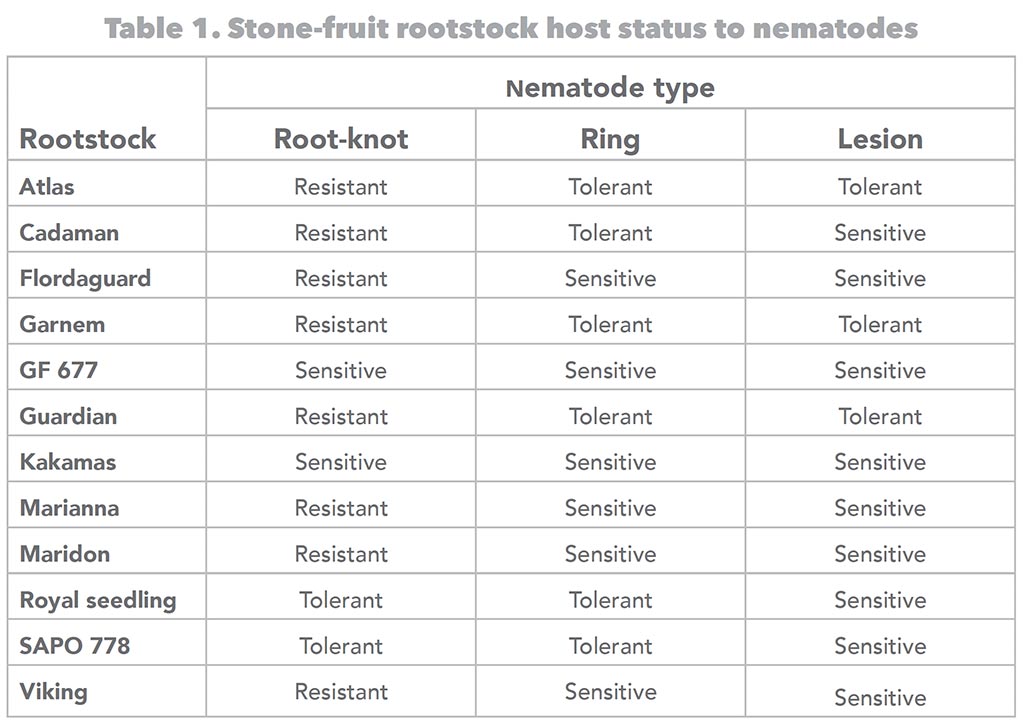
True resistance only occurs for root-knot nematodes and has been bred into many of the commercial rootstocks. Marianna, Maridon, and Flordaguard are immune to root-knot nematodes, which means root-knot nematodes cannot infect them at all.
None of the rootstocks are resistant to ring nematodes, but some maintain slightly lower numbers than others.
While resistance against lesion nematodes is possible, it is species-specific, targeting Pratylenchus penetrans. “In South Africa, 90% of lesion nematodes are Pratylenchus vulnus, for which there is no known resistance,” said Knoetze.
In planning a new orchard, growers should start by assessing the site history. If it housed a nematode host, the risk of nematode infections after replanting is elevated. Stone-fruit trees are not the only hosts of nematodes. For example, black wattle (Acacia mearnsii) and Port Jackson (A. saligna) are good hosts for ring nematodes.
Growers should also perform soil tests, keeping in mind that ring nematodes sometimes have patchy distributions or low numbers in fallow soils.
At sites where root-knot nematodes are known to be a problem, growers can select resistant rootstocks. For the other nematodes, no rootstock is resistant, but growers can choose rootstocks that are worse hosts or have better tolerance.
In conclusion, Knoetze pointed growers to the rootstock evaluation data presented by Chad van Wyk of Provar (see the article on p66). “Nematodes are not the only factors to consider,” he said. “We must also look at rootstock attributes such as susceptibility to other soil-borne pathogens and sensitivity to, for example, soil pH and waterlogging.”


