SATI is funding three plastics projects aimed at responding to critical questions posed by growers. By Eunice and Jan Avenant, and Tarryn Wettergreen
Prompted by crucial unanswered questions from growers, a project team led by Eunice Avenant embarked on three SATI-funded projects that started officially in August 2025.
This summarises preliminary results from the three projects. The findings hinge on one season of data that indicates the beneficial impacts of using plastic covers on production and quality in all three projects.
Project 1: Overhead nets and plastic covers as climate-improving systems (Orange River region)
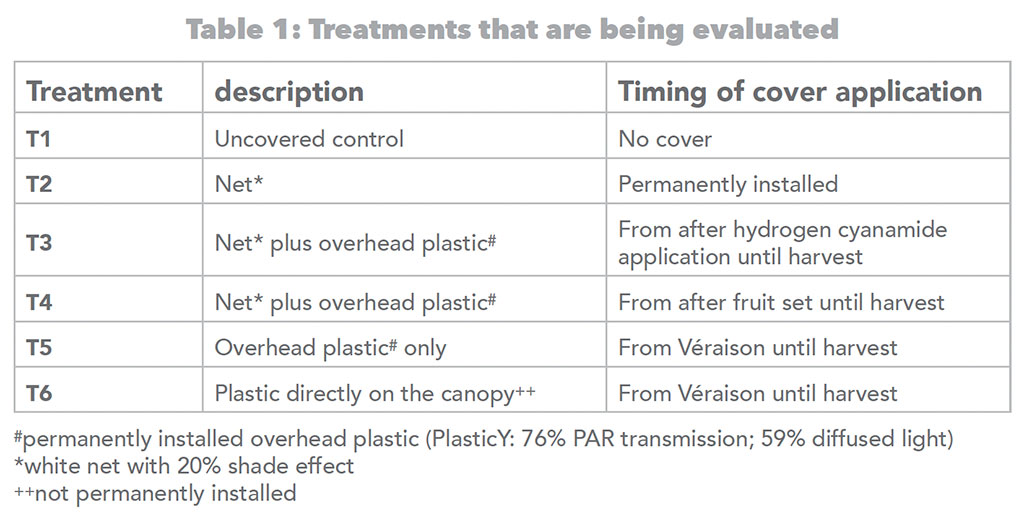
The vineyard was established in 2018 at Roepersfontein, Kanoneiland, using IFG Ten on Ramsey rootstock. The objective of this trial is to determine how different net and plastic-cover systems influence vineyard microclimate, yield, fruit quality and postharvest performance.
Preliminary findings
All plastic-cover treatments (T3-T6) produced significantly higher yields than the uncovered control.
T4 (overhead plastic applied after fruit set) achieved the highest export yield and showed superior berry firmness and pedicel condition after cold storage.
T4, T5 and T6 emerged as the most promising treatments for further investigation.
T3 is not recommended, as it resulted in the highest cull percentage and lowest export percentage due to brown physical markings on the fruit.
Covering technique 2 evaluated in Project 2 (Hex River Valley) SUPPLIED BY EUNICE AVENANT
Microclimate data
All cover systems transmitted sufficient light for photosynthesis. Wind speed was reduced under cover systems, while temperatures remained within acceptable ranges for grapevine physiological processes. Conditions favourable for berry cracking were not recorded during ripening and harvest.
Project 2: Rain protection covers for harvest timing manipulation (Hex River Valley)
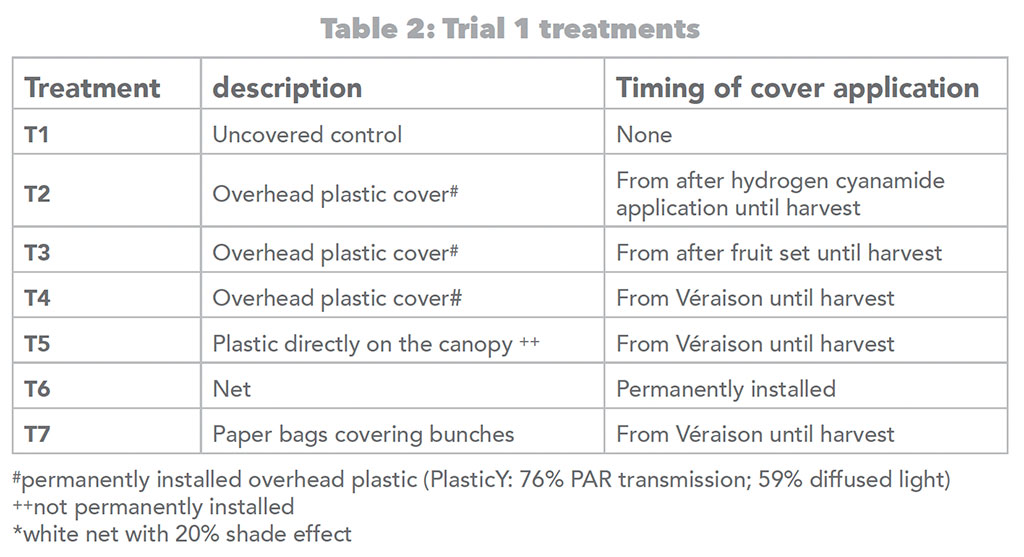
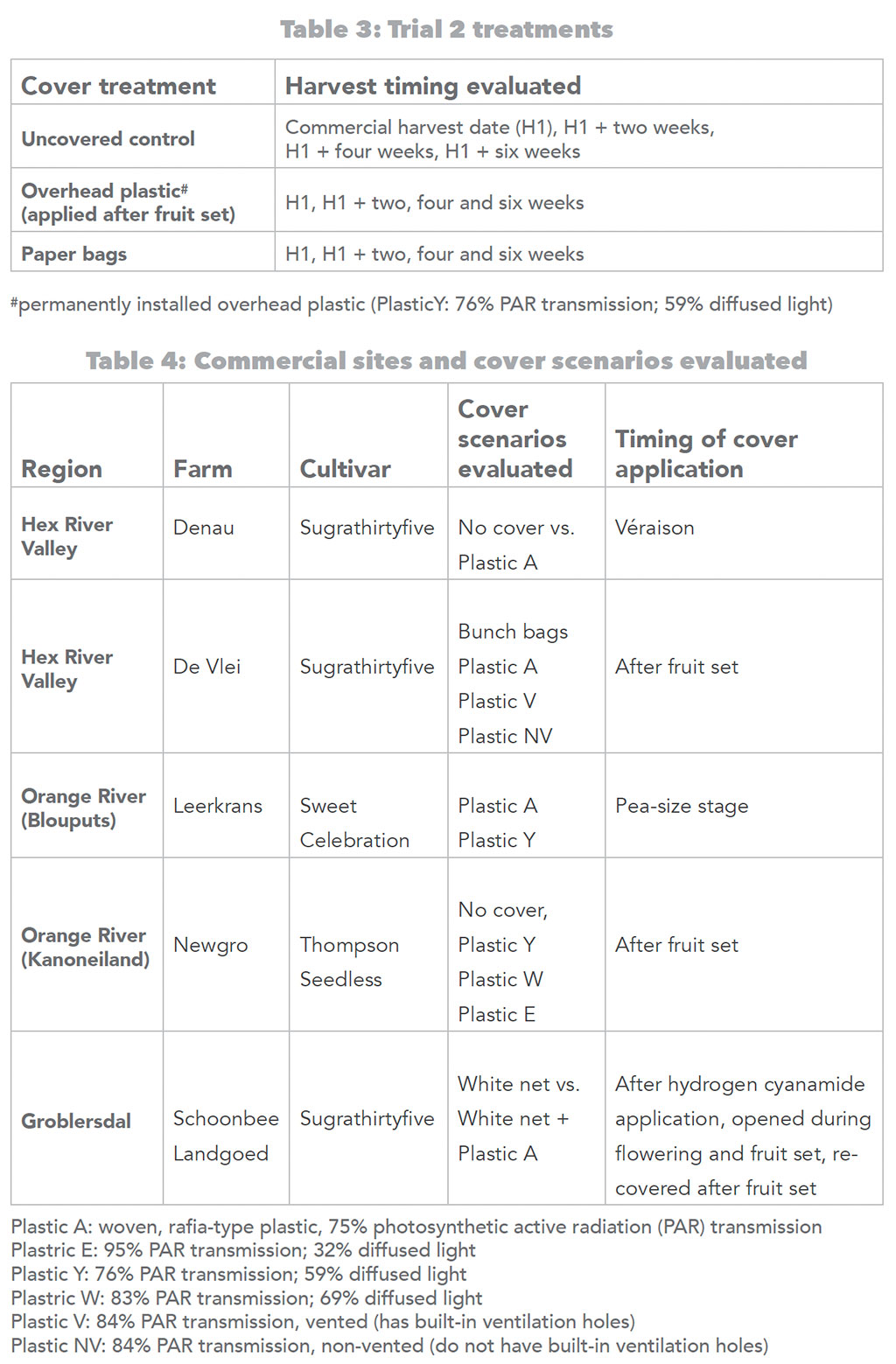
The vineyard was established in 2019 at De Hoop in the Hex River Valley, using Sugrathirty- five grafted onto Ramsey rootstock. The study investigates protection systems (overhead plastics, nets and bunch bags) to protect grapes from rain and to manipulate harvest timing, particularly by delaying harvest while maintaining fruit quality. The experimental site comprises two complementary trials: Trial 1, which evaluates a range of overhead cover protection systems applied at different developmental stages, and Trial 2, which assesses the potential of selected cover treatments and bunch bags to extend harvest timing through staggered harvesting dates.
Key findings
Plastic-covered treatments generally showed slower ripening than the control.
In Trial 1, treatments T3, T4 and T5 demonstrated potential to delay harvest.
In Trial 2, harvest date could be delayed by approximately two to four weeks with use of covering treatments.
Plastic covers reduced decay and berry cracking compared with uncovered vines.
Plastic covers and paper bags did not, however, completely prevent postharvest berry cracking.
Microclimate data
All systems maintained adequate light levels for photosynthesis and temperatures remained below critical thresholds. High humidity and dew-point conditions during ripening and harvest created favourable conditions for berry cracking and microcrack development.
Project 3: Practical industry evaluation of plastic covering materials (commercial validation trials)
Unlike Projects 1 and 2, Project 3 did not involve replicated treatment comparisons. Instead, commercial vineyards across production regions evaluated different plastic-cover products under practical farming conditions. As noted by the project team, these should be regarded as evaluation scenarios rather than treatments.
The different cover materials were evaluated for one or more of the following purposes:
rain protection
microclimate modification
harvest-delay potential.
Key findings
Advanced ripening under covers was recorded at several commercial sites, including Blouputs, Groblersdal, Newgro and Denau.
Microcracks and berry cracking occurred under both covered and uncovered conditions during periods of high humidity.
Similar observations were recorded in Project 2, suggesting that plastic covers alone cannot eliminate cracking when environmental conditions are highly conducive to its development.
Overall recommendation
Preliminary results from the first season indicate that plastic-cover systems have significant potential to improve table-grape production and quality, while also offering opportunities to manipulate harvest timing. In Project 1, several cover treatments increased yield, export pack-out and fruit condition, while Project 2 demonstrated the potential to delay harvest by up to several weeks and reduce decay and berry cracking.
Commercial evaluations in Project 3 provide evidence that plastic covers can modify vineyard microclimate and influence ripening patterns under commercial conditions. However, berry cracking and microcracks were still observed under both covered and uncovered conditions. This highlights the important role of environmental factors, particularly humidity, in determining outcomes. As these findings are based on a single season, further evaluation is required before definitive recommendations can be made.
We use cookies on our website to give you the most relevant experience by remembering your preferences and repeat visits. By clicking “Accept All”, you consent to the use of ALL the cookies. However, you may visit "Cookie Settings" to provide a controlled consent.
This website uses cookies to improve your experience while you navigate through the website. Out of these, the cookies that are categorized as necessary are stored on your browser as they are essential for the working of basic functionalities of the website. We also use third-party cookies that help us analyze and understand how you use this website. These cookies will be stored in your browser only with your consent. You also have the option to opt-out of these cookies. But opting out of some of these cookies may affect your browsing experience.
Necessary cookies are absolutely essential for the website to function properly. These cookies ensure basic functionalities and security features of the website, anonymously.
Cookie
Duration
Description
cookielawinfo-checkbox-analytics
11 months
This cookie is set by GDPR Cookie Consent plugin. The cookie is used to store the user consent for the cookies in the category "Analytics".
cookielawinfo-checkbox-functional
11 months
The cookie is set by GDPR cookie consent to record the user consent for the cookies in the category "Functional".
cookielawinfo-checkbox-necessary
11 months
This cookie is set by GDPR Cookie Consent plugin. The cookies is used to store the user consent for the cookies in the category "Necessary".
cookielawinfo-checkbox-others
11 months
This cookie is set by GDPR Cookie Consent plugin. The cookie is used to store the user consent for the cookies in the category "Other.
cookielawinfo-checkbox-performance
11 months
This cookie is set by GDPR Cookie Consent plugin. The cookie is used to store the user consent for the cookies in the category "Performance".
viewed_cookie_policy
11 months
The cookie is set by the GDPR Cookie Consent plugin and is used to store whether or not user has consented to the use of cookies. It does not store any personal data.
Functional cookies help to perform certain functionalities like sharing the content of the website on social media platforms, collect feedbacks, and other third-party features.
Performance cookies are used to understand and analyze the key performance indexes of the website which helps in delivering a better user experience for the visitors.
Analytical cookies are used to understand how visitors interact with the website. These cookies help provide information on metrics the number of visitors, bounce rate, traffic source, etc.
Advertisement cookies are used to provide visitors with relevant ads and marketing campaigns. These cookies track visitors across websites and collect information to provide customized ads.