Background
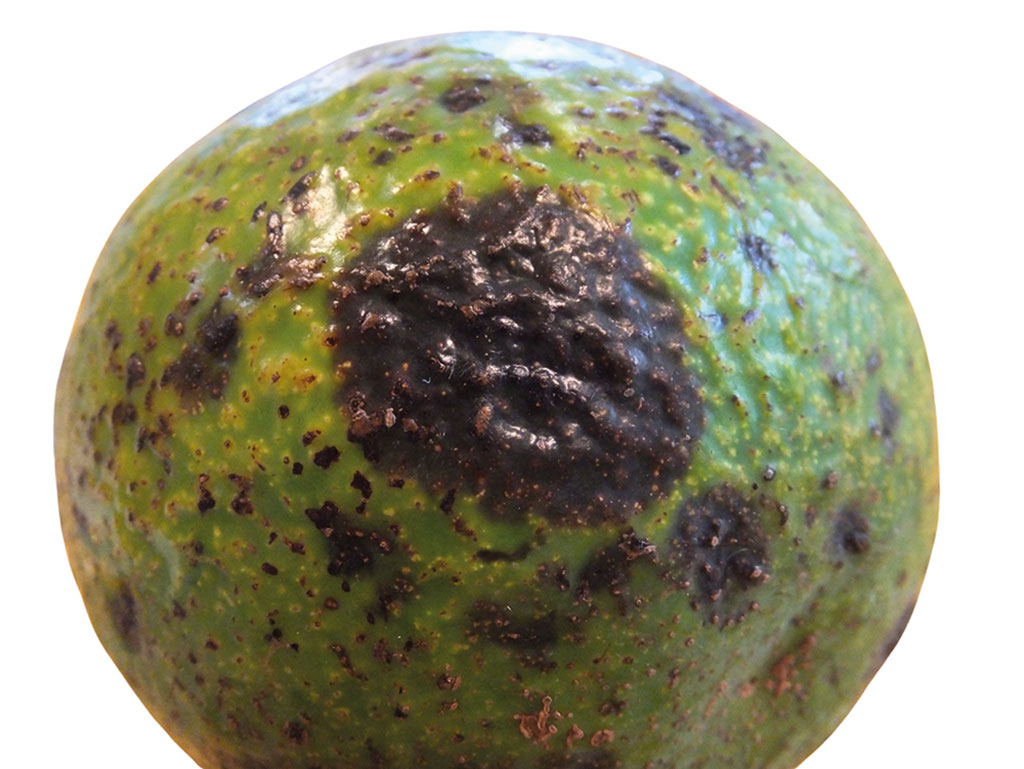
Avocados endure an onslaught from several fungal pathogens in the orchards, which mostly initiate latent pre-harvest infections in young fruit.
Cunningly, fungal pathogens like anthracnose infect fruit asymptomatically. They create a disease-free façade by remaining motionless inside the fruit. Then they pounce at the ripening phase when antifungal compounds like phenols that protect the unripe fruit, are no longer present. The fungal damage, says Laing, occurs only once the fruit have ripened, making it unsalvageable and disappointing for consumers.
It was becoming clear that dependence on systemic, curative fungicides like Prochloraz would no longer be a viable option. On 31 December 2023, the EU dropped the MRL of Prochloraz in avocado fruit so low – 0.03 ppm – that it would no longer work, effectively banning it in fruit destined for the EU markets.
 Project objectives
Profs Laing and Kwasi Sackey Yobo, and the participating students had their work cut out – 30-70% (R9 billion worth) of avocado losses had to be mitigated with a robust combat strategy.
Their primary goals were to:
- develop a pre-harvest biocontrol agent to stop fruit from being infected by the initial infectious phase of postharvest pathogens in the orchard
- optimise rapid Hot Water Treatments (rHWT) for avocado pack houses
- test Ultraviolet-C as an alternative technology to rHWT
- screen a range of edible food film products for the preventative control of postharvest diseases in avocados.
Combat strategy
They devised a three-pronged combat strategy – pre-harvest in the orchard, and postharvest for both the pack house, and once the fruit were ready to leave the pack house.
In the orchard
First, they needed to treat the fruit pre-harvest in the orchard, using a biocontrol agent to build protection into young fruit against being infected by postharvest pathogens.
Symbiosis
An important part of this pre-harvest phase in the combat strategy is the symbiotic relationship between the tree and the endophytic biocontrol fungi.
Endophytes infect the skin of leaves, shoots, flowers and fruit.
They come in peace, for a reciprocal, long-term union with the tree. During infection, the endophyte communicates biochemically with the host plant (i.e., the avocado tree), declaring its friendly status. The deal is that the skin of the fruit feeds them and in return, they control pathogenic fungi that attack the fruit skin.
So, Laing and his team set out to find suitable endophytic fungi to lay the groundwork for establishment of a symbiotic relationship. This approach has proven successful with cacao in Brazil and to protect Acacia mangium in Australia, he notes. To date, the team has isolated several biocontrol strains of Trichoderma that can infect the skin of avocado leaves and fruit. These strains also kill the main fungal pathogens attacking avocado fruit. Greenhouse and field trials remain to be completed in 2026.
In the pack house
Most avocados arrive in the pack house having already been infected by key postharvest fungal pathogens.
In the absence of Prochloraz, the harvested fruit would need to undergo a rapid Hot Water Treatment (rHWT) or Ultraviolet (UV) treatment to kill latent infections by postharvest fungi that cause anthracnose and stem-end rot, in particular.
Rapid Hot Water Treatment (rHWT)
Laing emphasised the importance of speed, efficiency, and the correct temperature when applying the rHWT method – an Israeli brainchild. Like a vaccination, rHWT triggers the immune system of the fruit, resulting in the release of phytoalexins into the fruit. These are natural fungicides that kill latent fungi in the skin.
He and his team devised the perfect “recipe”: 15-30 seconds at a temperature range of 56–60°C. With this treatment, the fruit is undamaged and the immune system is triggered. However, if there is an “overdose”, say a Hot Water Treatment for one minute, the fruit would be injured, the immune system disabled, and the postharvest fungi would infect the fruit 100%.
Notwithstanding Laing’s 20 years of dedicated rHWT research, the superior efficiency of UV-C light necessitated a pivot to developing this technology for avocado treatments.
UV-C light treatment
Researchers have found that UV light at key wavelengths, especially UV-C, triggers the release of natural fungicides. This is the same reaction as rHWT in fruit and vegetables. The result is a strong internal disease resistance reaction, enhanced nutrient content (such as antioxidants), slowed climacteric ripening, and extended shelf life.
Pulsed Light Treatment – a new technology – is an alternative to UV-C. In a single concentrated pulse of light lasting only one second, the unit generates light in a wide range of wavelengths, from visible light to the far end of UV light. This technology appears to be extremely powerful and may be more effective than UV-C. One of these units is being investigated by Laing and Yobo at UKZN.
When fruit are ready to leave the pack house
Laing and his team explored two options to ensure that the fruit have a protective layer that prevents infection during the shipping and retail process.
Biocontrol yeast Certain biocontrol yeasts can control the germination and growth of postharvest pathogens on fruit. The yeasts also replicate themselves and colonise wounds.
The team has found excellent strains that are viable biocontrol agents to fully protect fruit from the main pathogens of avocado. The commercialisation and registration of a biocontrol yeast strain require further extensive testing, formulation, large scale production, and storage tests, followed by a lengthy registration process. Hence, this is a long-term solution.
Protective coating As a preventative measure, it would be useful to be able to apply an antifungal fruit coating against subsequent infections during storage, transport, ripening, the retail process, and consumers’ handling of the fruit. Such a product would need to be a safe food coating, labelled as a “generally regarded as safe” (GRAS) product.
The team identified Gum Arabic and chitosan as ideal GRAS products for postharvest decay control. Gum Arabic comes from acacia trees, whereas chitosan is a natural, biodegradable polymer derived from shellfish.
They conducted numerous trials to determine the ideal concentrations and settled on 12–15% Gum Arabic as being the most effective for the gum by itself. However, growers will have difficulty mixing this much Gum Arabic with water, as it makes the fruit sticky to the touch and a reduced concentration of Gum Arabic requires the addition of an antifungal GRAS compound like chitosan or potassium silicate. The team is working on further trials to be able to produce a viable product composition as a preventative treatment for avocados.
Detecting infected fruit
Simphiwe Tseku (an MSc student) worked on a project to see if it was possible to detect diseased fruit using a small, portable, low-powered,, battery-operated Near-Infrared (NIR) scanner. The calibration models are excellent for detecting diseased flesh directly, using a fruit that has been cut open. It can also detect diseased flesh through the skin of an avocado, but not very accurately.
NIR technology has already been successfully implemented to grade fruit in several new pack houses in the South African avocado industry.
Detecting ripeness
At the same time, Tseku tested the NIR unit for its ability to detect ripe fruit. It did this reasonably well but struggled to penetrate the thick skin of Hass avocado fruit. Again, a high-powered NIR scanner could penetrate the skin better, and give an accurate ripeness classing, to send fruit into the correct bins for different ripeness classes.
Detecting maturity
Deciding when avocado fruit is mature is a difficult task for avocado growers. Mature fruit will ripen into a creamy edible fruit, whereas immature fruit will never ripen properly, and stay watery and tasteless. The NIR unit worked well in estimating ripeness, using dry matter content as the reference measurement of maturity. Using the portable scanner, this technology could be used by avocado growers to make decisions on whether to pick avocado fruit in an orchard.
Most of the aspects of this project have been completed, pending a few additional experiments.
Avocado growers and the industry stand to benefit significantly from the outputs of this research.
Acknowledgements
Researchers
- Professor Emeritus Mark Laing
- Prof. Kwasi Sackey Yobo
Stakeholder
- South African Subtropical Growers’ Association
- Contact: Dr James Mehl
- Technical Specialist: Market Access and SAAGA, SALGA Research Coordinator
Participating students
- Thembeka Majola (Post-Doctoral Fellow: Plant Pathology)
- Sfundo Ndlazi (MSc Plant Pathology)
- Simphiwe Tseku (MSc Plant Pathology)
- Previously Londeka Mkhize (MSc Plant Pathology)
- Onosizo Asimdumise Zondi (MSc Plant Pathology)
The Post-Harvest Innovation (PHI) Programme is a public-private partnership between the Fresh Produce Exporters’ Forum (FPEF) and the Department of Science, Technology and Innovation (DSTI), with the FPEF serving as the implementing agent. Research and development (R&D) projects are co-funded on a 50-50 basis by the DSTI and participating industry associations.