The first two seasons already offer promising results for weed suppression in table-grape vineyards. By Anna Mouton
“The benefits of cover crops have been shown for wine-grape vineyards in all regions – the cultivation of annual cover crops in the winter-rainfall areas is almost a standard practice in wine-grape vineyards,” says Dr Carolyn Howell, Senior Researcher at the ARC Infruitec-Nietvoorbij.
Although cover crops could likewise be advantageous to table-grape vineyards, less research supports their use. Hence, SATI is funding a five-year project led by Howell to investigate the effects of different cover-crop systems in table-grape vineyards.
The experimental layout
Howell’s trial site is a young commercial IFG Ten vineyard on a medium-textured soil in Paarl. The first cover crops were sown in 2023, with annual sowing planned until autumn 2027. Cover crops are limited to the work row.
The four cover-crop treatments are Pallinup oats, grazing vetch, a yearly rotation of triticale and medicks, and a mixture of triticale and lupins. The control is the farm’s standard management practice: planting fescue. Cover-crop establishment follows the guidelines in Cover Crops in South African Vineyards (available from SATI).
In addition to the different cover crops, Howell and her team are assessing two management practices. Cover crops are either slashed and spread in the vine row before bud break, or chemically terminated but left in the work row.
“We’re focusing on the effect of cover crops and the placement of the plant residues on the soil responses, the nitrogen status of the soil and grapevines, and the grapevine responses,” explains Howell.
Her team, under the expert guidance of Technical Team Leader Karen Freitag collects samples for gravimetric determination of soil water content (the soil is weighed before and after drying to calculate its water content); soil, leaf blade and petiole analysis; berry mass, size distribution, and yield; and postharvest fruit quality.
They also measure cane mass at pruning and the dry matter production of cover crops and weeds for each treatment.
The results so far
“Cover-crop cultivation is a long-term process,” says Howell. “All the research has shown this.” Nonetheless, her data from the first two seasons (2023 and 2024) already display some promising trends.
In 2023, cover crops and weeds produced ample dry matter, despite late sowing. “Due to logistical problems following COVID, we could only sow in May 2023,” says Freitag. “We would ideally sow in early April.”
All four cover crops achieved more than 2.5 tonnes per hectare of dry mass. Two tonnes per hectare is considered sufficient to improve water infiltration and reduce soil erosion, and 2.5 tonnes per hectare is the level at which cover crops begin to suppress weeds. In contrast, the fescue control produced almost no dry matter.
Weed dry matter production was less than 1 tonne per hectare for all cover crops, but about 1.5 tonnes per hectare for the fescue control.
In 2024, both cover crops and weeds suffered a setback due to heavy rains in July and August. “It was too wet,” recalls Freitag. “Even the white clover on the farm was struggling.”
Nonetheless, the oats and the triticale-lupin mixture still produced more dry matter than the threshold required to suppress weeds and improve water infiltration.
“If I were a farmer, I would adopt cover crops just for the weed suppression,” comments Howell.
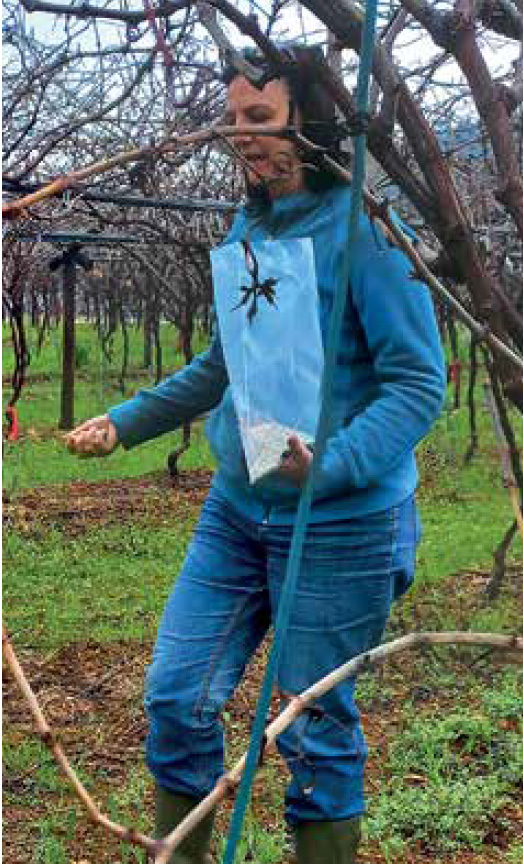
Karen Freitag fertilises the cover crops
Other potential benefits
With half the data collection still to go, conclusions about the cover crops’ effects on the soil and the grapevines would be premature.
However, extensive work in vineyards (mostly wine grapes) by several researchers, notably the late Dr Johan Fourie, a respected researcher at the ARC Infruitec-Nietvoorbij and author of Cover Crops in South African Vineyards, showed that cover crops can:
Boost organic matterIn long-term cover-crop trials, Fourie demonstrated significant increases in soil organic carbon with several cover crops. For example, a rye cover crop more than doubled soil carbon (from 0.55% to 1.24%) on a sandy loam soil near Stellenbosch over 10 years.
Reduce fertilisationCover crops can augment the nitrogen available to vines, allowing growers to cut back on synthetic fertilisers. Nitrogen fixers, such as legumes, increase soil nitrogen directly, and other cover crops increase nitrogen indirectly by adding soil organic matter. Of course, excess nitrogen, especially when poorly timed, can be detrimental to fruit quality and storability (this was discussed in a December 2025 SAFJ article).
Improve water infiltrationWater droplets impacting bare soil can cause crusting of the uppermost few millimetres of soil. “Even though that crust is thin, it acts as a seal, preventing water from going into the soil,” says Howell. By protecting the soil surface, living cover crops and the mulch they create after termination prevent crusting and reduce run-off and erosion.
Howell points to research by Kobus Louw, in which he showed that a living cover crop or a straw mulch decreased rain run-off by more than 25%, as measured over 34 rainfall events, and water run-off by more than 37%, as measured during a 46 mm irrigation event (applied at 12 mm per hour).
Save water and energyWhen mechanically or chemically terminated before bud break, cover crops form a mulch that reduces evaporative losses. Reduced irrigation demand saves water, as well as electricity for pumping it. Howell cites results generated by Dr Philip Myburgh on the effect of mulch on evaporation from the soil surface after irrigation.
He reported approximately 8 mm of evaporation from bare soil for the first day after irrigation, compared with about 5 mm from mulched soil. After three days post-irrigation, daily evaporation from the bare and mulched soil was the same.
Protect fruit qualityWhile conducting a field trial in a table-grape vineyard near Keimoes, Fourie observed a heat wave’s effects during véraison.
Bunch damage was significantly less in the treatments with a mulch derived from a vetch or oats cover crop (terminated before bud break) than in treatments without a cover crop or with dwarf fescue.
“I see cover crops as positive in terms of all these benefits, and for sustainability,” says Howell. “Consumers want to see these types of practices.”
We use cookies on our website to give you the most relevant experience by remembering your preferences and repeat visits. By clicking “Accept All”, you consent to the use of ALL the cookies. However, you may visit "Cookie Settings" to provide a controlled consent.
This website uses cookies to improve your experience while you navigate through the website. Out of these, the cookies that are categorized as necessary are stored on your browser as they are essential for the working of basic functionalities of the website. We also use third-party cookies that help us analyze and understand how you use this website. These cookies will be stored in your browser only with your consent. You also have the option to opt-out of these cookies. But opting out of some of these cookies may affect your browsing experience.
Necessary cookies are absolutely essential for the website to function properly. These cookies ensure basic functionalities and security features of the website, anonymously.
Cookie
Duration
Description
cookielawinfo-checkbox-analytics
11 months
This cookie is set by GDPR Cookie Consent plugin. The cookie is used to store the user consent for the cookies in the category "Analytics".
cookielawinfo-checkbox-functional
11 months
The cookie is set by GDPR cookie consent to record the user consent for the cookies in the category "Functional".
cookielawinfo-checkbox-necessary
11 months
This cookie is set by GDPR Cookie Consent plugin. The cookies is used to store the user consent for the cookies in the category "Necessary".
cookielawinfo-checkbox-others
11 months
This cookie is set by GDPR Cookie Consent plugin. The cookie is used to store the user consent for the cookies in the category "Other.
cookielawinfo-checkbox-performance
11 months
This cookie is set by GDPR Cookie Consent plugin. The cookie is used to store the user consent for the cookies in the category "Performance".
viewed_cookie_policy
11 months
The cookie is set by the GDPR Cookie Consent plugin and is used to store whether or not user has consented to the use of cookies. It does not store any personal data.
Functional cookies help to perform certain functionalities like sharing the content of the website on social media platforms, collect feedbacks, and other third-party features.
Performance cookies are used to understand and analyze the key performance indexes of the website which helps in delivering a better user experience for the visitors.
Analytical cookies are used to understand how visitors interact with the website. These cookies help provide information on metrics the number of visitors, bounce rate, traffic source, etc.
Advertisement cookies are used to provide visitors with relevant ads and marketing campaigns. These cookies track visitors across websites and collect information to provide customized ads.