Allée Bleue
The 2026 Hortgro Science Stone-fruit Orchard Walk provided the opportunity to compare the performance of different rootstocks side-by-side. By Anna Mouton
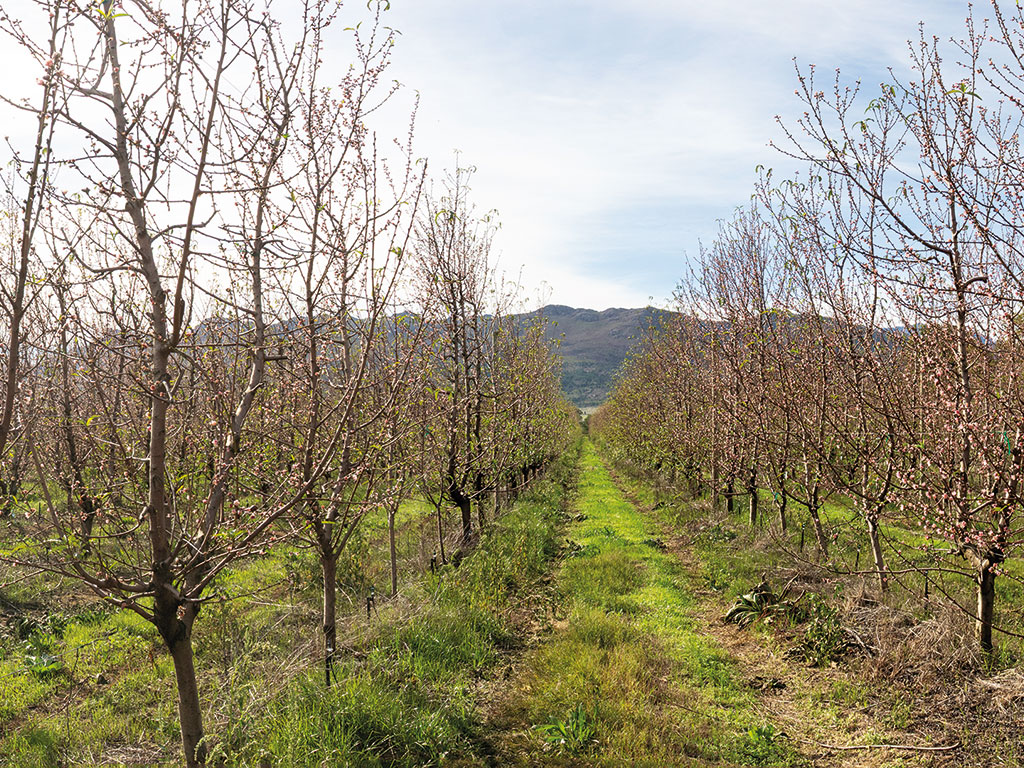
A record number of participants attended the 2026 Hortgro Science Stone-fruit Seminar and Orchard Walk in Simondium. Charl Stander of Freshness First coordinated the event, and the orchard visits were hosted by Allée Bleue and facilitated by Stander, Douw Willemse of Allée Bleue, and Andrew Hacking of Ad Lucem Agricultural Services.
The programme included Angeleno on Atlas and Guardian, Ruby Star on Atlas and Viking, Ruby Sun on Marianna and Viking, and Sunectwentyone on Flordaguard.
Angeleno
The Angeleno blocks on Atlas and Guardian were both planted at 3.5 x 1.5 metres in 2020. In their most recent season, the trees on Atlas yielded 10 tonnes per hectare with an 83% Class-1 pack-out (12% AA, 34% A, and 30% B). The trees on Guardian yielded 18 tonnes per hectare, also with an 83% Class-1 pack-out (10% AA, 31% A, and 32% B).
“We struggle to get set on these trees,” said Willemse. “We have 10% Souvenir in the row for cross-pollination, and I planted another 10% Harry Pickstone between the trees afterwards.” He suspects that Atlas might not be the best fit for Angeleno, as Atlas awakens relatively late, so it may not supply sufficient reserves to the scion during flowering and fruit set.
Technical adviser and stone-fruit grower Petru du Plessis pointed out that Angeleno is difficult to set, suggesting that it calls for more cross-pollinators and beehives than easier-to-set cultivars.
“Normally, you can get 4 000-6 000 cartons per hectare on Angeleno, which generates a potential income of R650 000-R750 000,” said Du Plessis. “We usually put four to five hives per hectare, which costs us around R6 000. So, double up, and spend R12 000 or even R15 000 per hectare on hives, to improve the fruit set and protect your income.”
Poor fruit set can also result from poor pollination when the main cultivar and the cross-pollinators don’t flower simultaneously. “I think we need to apply rest-breaking to most plums to synchronise cross-pollination,” said Hacking, speaking at the Ruby Star blocks, which also set poorly in the most recent season.
Other reasons for poor set include bad weather during pollination and overly vigorous trees.
Both Angeleno blocks had profile holes, allowing participants to see that the root development looked similar for Atlas and Guardian. Both were taking advantage of the good soil to root deeply. But Willemse highlighted an important difference.
“Two years ago, we had a lot of rain, the river came down, and there was standing water in a part of this orchard,” he said. “We lost many trees on Atlas, but none on Guardian. On our premises, if the winter is wet, you have problems with Atlas in the subsequent season.”
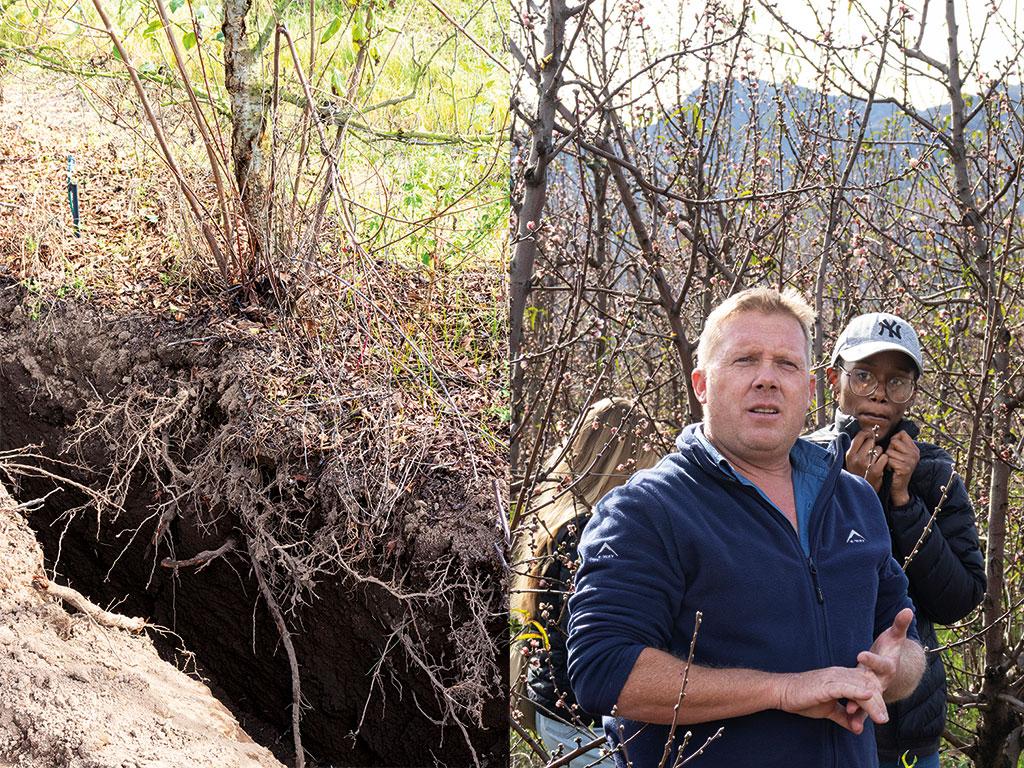
Right: Douw Willemse from Allée Bleue, the host of the 2026 Hortgro Science Stone-fruit Orchard Walk.
Credit: Anna Mouton
Ruby Star
Like the Angeleno blocks, the Ruby Star blocks on Atlas and Viking were both planted at 3.5 x 1.5 metres in 2020. The cross-pollinators in both blocks are 10% Songold.
In their most recent season, the trees on Atlas yielded 23 tonnes per hectare with a 75% Class-1 pack-out (24% AA, 29% A, and 12% B). The trees on Viking yielded 22 tonnes per hectare, also with a 75% Class-1 pack-out (31% AA, 25% A, and 8% B).
According to Hacking, Viking has enjoyed greater success than Atlas as a plum rootstock and is increasingly being adopted for peaches and nectarines.
“In the original trials for peaches and nectarines, planted by Piet Stassen, Viking wasn’t included, and Atlas came out number one,” he said. “But we’re moving more to Viking than Atlas for peaches.”
He referred to another farm where Atlas and Guardian are both growing on sandier soils, and Guardian is delivering better production. On sites where a limiting soil layer periodically causes wet conditions, he thinks Viking will cope better than Atlas, which will do better than Kakamas. Flordaguard and GF 677 will likely fare the worst.
Nematode tolerance was discussed, as Allée Bleue is a replant site with recurring nematode problems. “We test for nematodes every three years, and we treat if we need to,” said Willemse. “We see good results within the first season after treatment.”
While many stone-fruit rootstocks (with the notable exceptions of GF 677 and Kakamas) are resistant or tolerant to root-knot nematodes, none are resistant to ring nematodes, as Dr Rinus Knoetze pointed out at his presentation during the Stone-fruit Seminar (summarised in the SA Fruit Journal Aug-Sep ’26).
Ruby Sun
The Orchard Walk Ruby Sun block on Viking was planted in 2020 at 3.5 x 1.5 metres. In its most recent season, it yielded 32 tonnes per hectare with an 83% Class-1 pack-out (37% AA, 26% A, and 5% B).
“If you look at the root system, you can see thick roots that penetrate to the middle of the work row,” said Stander. “The fine roots are well-distributed in the top 10-20 cm. This is well-drained soil.”
He contrasted this with another Ruby Sun block, on Marianna, also planted at 3.5 x 1.5 metres, which has sicklier trees. Across the industry, Ruby Sun often develops trunk infections that shorten the trees’ productive lifespan.
Nonetheless, the trees on Marianna had similar yields to those on Viking, albeit with slightly smaller fruit.
“Marianna has a flat root system consisting of a mass of roots in the top 20 cm, but no thick roots growing into the work row,” said Stander. “It wants soil with body: some organic carbon or above 10% clay to buffer temperature and moisture fluctuations.”
On the other hand, Marianna’s shallow roots enable it to survive wetter conditions than other stone-fruit rootstocks, especially as it can do well on ridged soils.
“Marianna is suited to soils that have the potential for waterlogging,” commented Du Plessis. “With climate change, we have the risk of black swan events where we get 100 mm of rain overnight in spring. If you have a rootstock that’s susceptible to drowning, that’s when you lose your orchard or part of your orchard.”
For Du Plessis, rootstock choice should factor in immediate risks, such as nematode pressure or soil type, without losing sight of the long-term risks posed by climate. Mention of climate led (as it does) to a discussion of netting.
“We will see more nets in future, whether for protection against sunburn, wind or hail, or for water savings,” said Stander. “But trees are more vigorous under nets, and we don’t have dwarfing rootstocks for stone fruit, so growers should consider adjusting their tree spacing.”
Sunectwentyone
The Orchard Walk included a brief detour into a Sunectwentyone block on Flordaguard, planted at 3.5 x 2.0 metres. The site previously also held nectarines.
Part of it was fallowed for two years before replanting, while the rest was replanted immediately.
“Replant disease has been tough on the part that wasn’t fallowed,” said Willemse. “We’ve treated for nematodes twice in seven years.”
The trees were already in flower, although it was only the end of May. “We struggle to get it to drop its leaves,” remarked Willemse, “and, as the scion cultivar is low chill, the new leaves start pushing as soon as the old ones drop.”
During the Orchard Walk, the topics of earliness versus lateness and chill requirement came up several times. Stander explained that these are different characteristics.
“The only stone-fruit rootstock with a very high chill requirement is SAPO 778,” he said. “that’s why you won’t see it at Allée Bleue. It doesn’t work here. The other rootstocks are more or less in the same category with regard to chill requirement.”
Within that medium-chill category, some rootstocks emerge earlier from dormancy than others. “For example, Atlas is a late sleeper. It only becomes active from the end of September, which is why it’s not ideal for Angeleno or, probably, Ruby Sun, as those are both early flowerers,” said Stander.
Flordaguard tends to be very early, making it a good match for the early Sunectwentyone. As with many early stone-fruit cultivars, obtaining good fruit size on Sunectwentyone can be problematic, especially when the season starts cold.
“We get about 20 tonnes per hectare on that orchard, and we try to get to a count 23 or 25,” said Willemse. “This year was difficult. Fruit size was small on all the early cultivars.”
Root depth also influences earliness or lateness. The soil warms up faster for shallow-rooting Marianna and sand-loving Flordaguard, helping them wake up earlier. But Viking, for example, dislikes hot, dry soils and roots deeply, where the soil is cooler. This affects how early it becomes active in spring.
Allée Bleue is fortunate to have excellent soils that suit a wide range of rootstocks. For now, they have identified Guardian, Marianna, and Viking as their best options for plums. But that doesn’t mean these are ideal for all sites, as Stander emphasised during the Orchard Walk.
“The choices you make are micro-choices,” he said. “You don’t make them based on an article about a successful grower in the Farmer’s Weekly. You need to know your soils and the characteristics of the rootstocks.”

Related Posts

Overhead plastics
Water scarcity and other adverse environmental conditions pose significant challenges for sustainable table-grape cultivation.

Overhead nets and plastic in SA table-grape production systems
SATI is funding three plastics projects aimed at responding to critical questions posed by growers.