Can cover crops help to build nematode communities that support grapevine health? By Anna Mouton
Many table-grape growers associate nematodes with root damage, even though plant parasites represent a tiny fraction of all nematode species. Most nematodes not only live blameless lives but could be powerful allies in the vineyard by recycling soil nutrients and suppressing their plant-parasitic relatives.
An ongoing SATI-funded project examining different cover crops includes an analysis of soil nematodes. “We all know that we’re moving to more sustainable farming,” says Gaylen Carelse. “So, we want to see what effect cover crops will have on soil nematodes, as well as on soil health and chemistry and grape yields and quality.”
Carelse is leading the project at ExperiCo Agri-Research Solutions. Dr Annika Pienaar initially led the project but has since moved to Corteva Agriscience.
Trial design and data collection
The trials were conducted in a full-bearing commercial IFG Ten vineyard, on sandy rocky soils in Paarl. Four cover-crop combinations were compared to a single-species control (Table 1).
Table 1. Cover-crop treatments used in the project. The singlespecies Barpower forage rye is the control.
No cover crops were present at the start of the trials. In the first season (2023), weeds were controlled manually. The researchers sowed the cover crops by hand a few days before predicted rainfall and covered them using rakes.
Unfortunately, the cover crops grew poorly in the first season and were outcompeted by weeds. Therefore, contact herbicides were applied after harvest in 2024, and the cover crops were resown and fertilised.
Cover crops in the vine row were chemically terminated, and those in the work row were rolled or mowed before summer.
The researchers measured compaction and collected soil samples for physical and chemical analysis before sowing in 2023. Follow-up samples were taken in April and October 2024. Nematode analysis was conducted in April and October 2024.
The team also collected data on the dry matter production of the cover crops, the vegetative growth of the vines, grape yields and quality, and decay risk in the vineyard before sowing and after the second season.
Most of the data analysis is ongoing, but the completed nematode counts point to improved soil health after only one season of cover crops.
Nematodes in numbers
A gram of soil can contain hundreds or even thousands of nematodes. Merely counting them provides little useful information: nematode species can differ widely across ecological niches. Trying to understand soil by lumping nematode species would be like trying to understand the savannah by batching lions and pangolins.
To make sense of nematode communities, scientists group the minuscule worms by their feeding habits (bacterivores, fungivores, omnivores, root-exudate feeders, plant parasites, and predators). Nematode numbers across groups are combined into indices that represent aspects of soil health.
For the SATI-funded project, Carelse is assessing the basal, structure, enrichment, and maturity indices.
The basal and structure indices (range 1-100) provide insight into soil food webs. Low basal and structure indices (0-30) indicate simple food webs, likely due to disturbance, whereas high basal and structure indices (60-100) indicate complex, structured food webs that include predators and omnivores. Ecologists consider complex food webs to be more productive, resilient, and stable.
The enrichment index (range 1-100) reflects food availability. A high enrichment index (60-100) is likely when a nutrient surplus boosts bacterial populations, followed by an increase in bacteria-feeding nematodes. In table grapes, a high enrichment index can be a sign of excessive nitrogen application.
The maturity index (range 1-5) is affected by environmental disturbance. Low values (less than two) usually accompany recent cultivation or nutrient spikes. High values (above three) are associated with stable and productive soils.
Figure 1.: The change in nematode indices from April to October 2024 for each treatment
Nematodes before and after
Overall, the trial site started with low basal, structure, and maturity indices and a high enrichment index. This is typical of bacterially dominated, disturbed, nitrogen-enriched soil with a low carbon-to-nitrogen ratio.
After one season, on average, the basal, structure, and enrichment indices had improved from poor to intermediate, and the maturity index was bordering on intermediate.
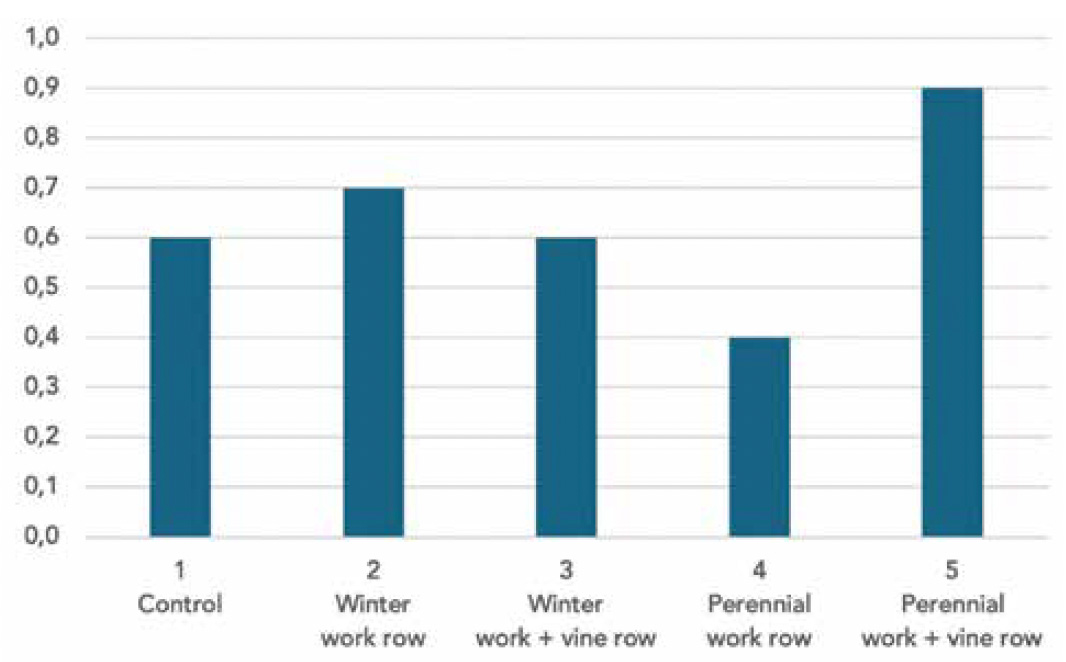
Figure 1 shows changes in the basal, structure and enrichment indices (these indices range from one to 100) from April to October 2024 for each treatment. Figure 2 shows the change in the maturity index (this index ranges from one to five).
Basal index readings improved for all the cover crops, even the standard single-species forage rye. The basal index is affected by the proportion of stress-tolerant, opportunistic nematodes, which will represent a smaller share of the total population as soil conditions improve.
Figure 2.: The change in maturity indices, April to October 2024 for each treatment
Although the structure index improved on average, it didn’t improve for all treatments. This is not unexpected, as the structure index is based on slowly reproducing nematodes, which take a long time to recover and may even be absent from degraded soil.
All treatments had lower enrichment indices (lower enrichment is good).
The maturity index also improved across all treatments.
These changes represent a modest step toward a mature, fertile soil with a moderate carbon-to-nitrogen ratio and a healthy balance of bacteria and fungi. Such soil is less likely to support pathogens.
Plant-parasitic nematode (ring, spiral, and stubby-root) numbers didn’t show a clear correlation with cover-crop treatments. Ring nematodes were detected in all the samples in both April and October, but always below the economic threshold of 125 nematodes per 250 cm3 of soil.
“Conservation agriculture is a slow process. You really need five or six years to see changes,” says Pienaar. “But looking at the data for the second season, it appears that the nematode community structure has already improved.”
For impatient growers, these trends are encouraging, but keep in mind that the results are preliminary. “We will be able to give more definite results after looking at the rest of the data and doing statistical analysis,” says Carelse. The final report is available from June 2026.
We use cookies on our website to give you the most relevant experience by remembering your preferences and repeat visits. By clicking “Accept All”, you consent to the use of ALL the cookies. However, you may visit "Cookie Settings" to provide a controlled consent.
This website uses cookies to improve your experience while you navigate through the website. Out of these, the cookies that are categorized as necessary are stored on your browser as they are essential for the working of basic functionalities of the website. We also use third-party cookies that help us analyze and understand how you use this website. These cookies will be stored in your browser only with your consent. You also have the option to opt-out of these cookies. But opting out of some of these cookies may affect your browsing experience.
Necessary cookies are absolutely essential for the website to function properly. These cookies ensure basic functionalities and security features of the website, anonymously.
Cookie
Duration
Description
cookielawinfo-checkbox-analytics
11 months
This cookie is set by GDPR Cookie Consent plugin. The cookie is used to store the user consent for the cookies in the category "Analytics".
cookielawinfo-checkbox-functional
11 months
The cookie is set by GDPR cookie consent to record the user consent for the cookies in the category "Functional".
cookielawinfo-checkbox-necessary
11 months
This cookie is set by GDPR Cookie Consent plugin. The cookies is used to store the user consent for the cookies in the category "Necessary".
cookielawinfo-checkbox-others
11 months
This cookie is set by GDPR Cookie Consent plugin. The cookie is used to store the user consent for the cookies in the category "Other.
cookielawinfo-checkbox-performance
11 months
This cookie is set by GDPR Cookie Consent plugin. The cookie is used to store the user consent for the cookies in the category "Performance".
viewed_cookie_policy
11 months
The cookie is set by the GDPR Cookie Consent plugin and is used to store whether or not user has consented to the use of cookies. It does not store any personal data.
Functional cookies help to perform certain functionalities like sharing the content of the website on social media platforms, collect feedbacks, and other third-party features.
Performance cookies are used to understand and analyze the key performance indexes of the website which helps in delivering a better user experience for the visitors.
Analytical cookies are used to understand how visitors interact with the website. These cookies help provide information on metrics the number of visitors, bounce rate, traffic source, etc.
Advertisement cookies are used to provide visitors with relevant ads and marketing campaigns. These cookies track visitors across websites and collect information to provide customized ads.