The berry cuticle
Grape berries are covered by a skin consisting of a thin outer layer of flattened epidermal cells and about a dozen inner layers of hypodermal cells. The hypodermal cells effectively merge with the berry flesh during ripening.
The epidermal cells secrete the waxy cuticle that protects the berry from dehydration and pathogens. “If you look at tomatoes and apples, they all have a relatively thick cuticle,” says Lashbrooke. “Grapes have a really thin cuticle compared to these other fruits. That’s one reason why cracking is such a big issue in table grapes.”
Cuticular synthesis mostly happens early in fuit development, probably until véraison in table grapes. After this, cuticular synthesis slows, but the berry expands rapidly, so the cuticle is stretched thinner and thinner.
At the same time, the berry is accumulating sugar. The higher the sugar levels inside the berry, the stronger the osmotic force pulling water from the berry surface into the berry flesh. Hence, riper berries are more susceptible to cracking.
In the co-funded project, Lashbrooke found that cultivars with extremely low °Brix didn’t crack. However, there wasn’t a linear relationship between cracking and °Brix in cultivars with °Brix ranging from 10.25 to 20.82.
Strength versus elasticity
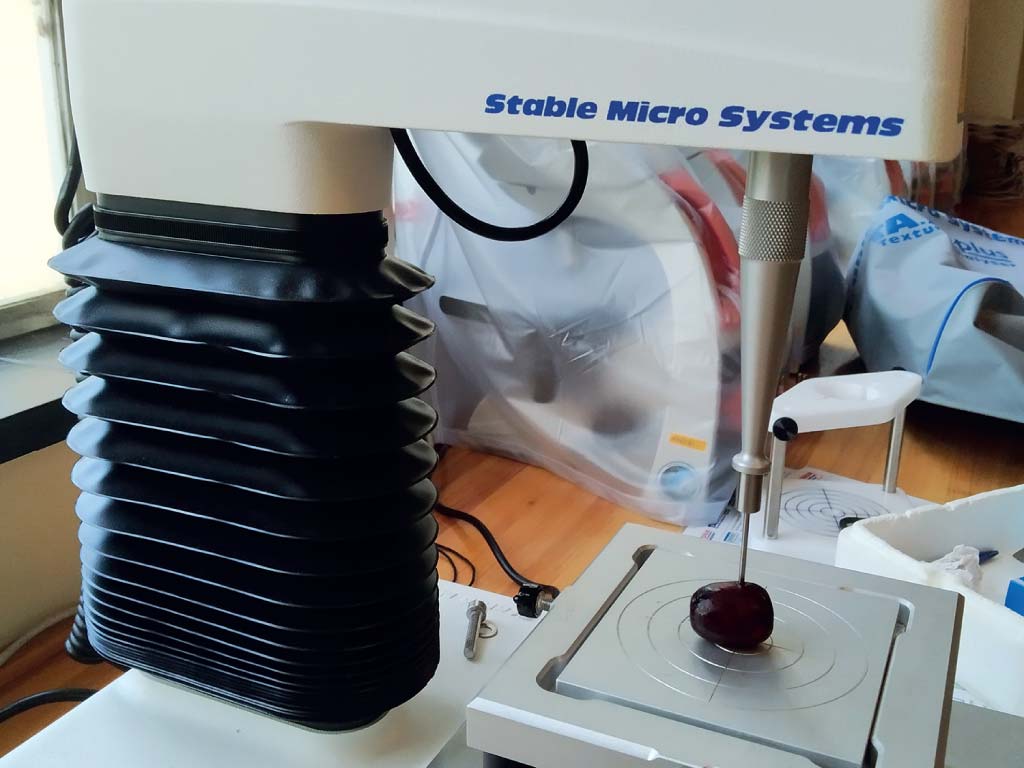
The strength of a berry skin can be seen as the force required to break it, and its elasticity as how much it can deform before breaking. Lashbrooke measured the strength and elasticity of the skins of 25 grape cultivars using a TA.XTplus texture analyser.
“The machine has two different modes of action,” explains Lashbrooke. “It can push a rod into the berry, or we can take the skin off the berry, and the device pulls it apart, sensing the resistance and the deformation until the skin breaks.”
Resistance is a measure of skin strength, whereas deformation is a measure of elasticity. Lashbrooke also assayed berries from the same bunches for cracking by submerging them for up to 20 hours in water containing a surfactant.
“Berries that were very strong were not necessarily resistant to cracking,” says Lashbrooke. “But berries that showed high elasticity were very crack resistant. The skin’s ability to move and stretch was significantly more important than its strength.”
He also reported that measuring elasticity by compressing the whole berry was far quicker and just as accurate as measuring it by pulling apart the berry skins.
Building blocks of cuticles
One of Lashbrooke’s research areas is the genetic basis of cuticle composition, as covered in an October 2024 SAFJ article, “Table-grape breeding in the genomic era”. He believes cuticle composition could hold the key to cultivar differences in cracking susceptibility.
“We suspect that the cuticle layer impacts stretchability, as this has been shown in work on lots of other fruit species around the world,” he says. Berry cuticles are complex structures containing waxes embedded in a cutin matrix. Cutin itself is a type of wax. Waxes include diverse organic compounds, but they’re all insoluble in water, which is why the waxy cuticles of plants help slow water loss.
For the project, Lashbrooke extracted the cutin and waxes from the skins of crack-susceptible and crack-resistant cultivars. He analysed the cutin and waxes using gas chromatography-mass spectrometry. Although he saw cultivar differences, these didn’t correlate to cuticle elasticity.
“The macrostructure of the cuticle, and how it interacts with the epidermal cell walls, could easily play a role,” says Lashbrooke. “We have pectins and carbohydrates that are part of the cell wall and bind to the fatty acids of the cuticle. And I think that interaction is very important.”
Unfortunately, while it’s possible to break berry cuticles down to their building blocks, that doesn’t tell you how those building blocks fit together. After all, you can’t guess the layout of a house from a pile of bricks and some bags of cement.
While theoretically possible, determining cuticle structure is difficult and expensive. So, it is not currently on the cards for grape berries.
Plant growth regulators
As plant growth regulators are already widely used in table-grape production, an important part of this study was to examine their effects on cracking susceptibility. Lashbrooke trialled products containing abscisic acid, gibberellins, and two types of cytokinins (6-benzyladenine and forchlorfenuron). Bunches were sprayed at véraison and again one week later. Doses were according to the manufacturers’ guidelines.
This part of the project ran over two seasons. Abscisic acid and gibberellins were ineffective in the first season, so they weren’t included in the second season. “Cytokinins were able to influence cuticle deposition, elasticity, and cracking in some cultivars,” says Lashbrooke. “But even cultivars that responded well in one season didn’t respond as strongly in another season.”
Cultivars are well-known to differ in their response to cytokinins, for example, when used for improving set or berry enlargement. So, Lashbrooke’s results are not surprising. “There’s great scope for follow-up research,” he says. “But we need to test cultivars in a much more controlled environment, and we need to spray them with different concentrations.”